The Annina Nosei Gallery
Paperback · Hardcover
Ships in 2 to 5 working days. Delivery quoted from your address at checkout.
3,785 words · no email, no account
No. 061 · Art & Design · Visual Art
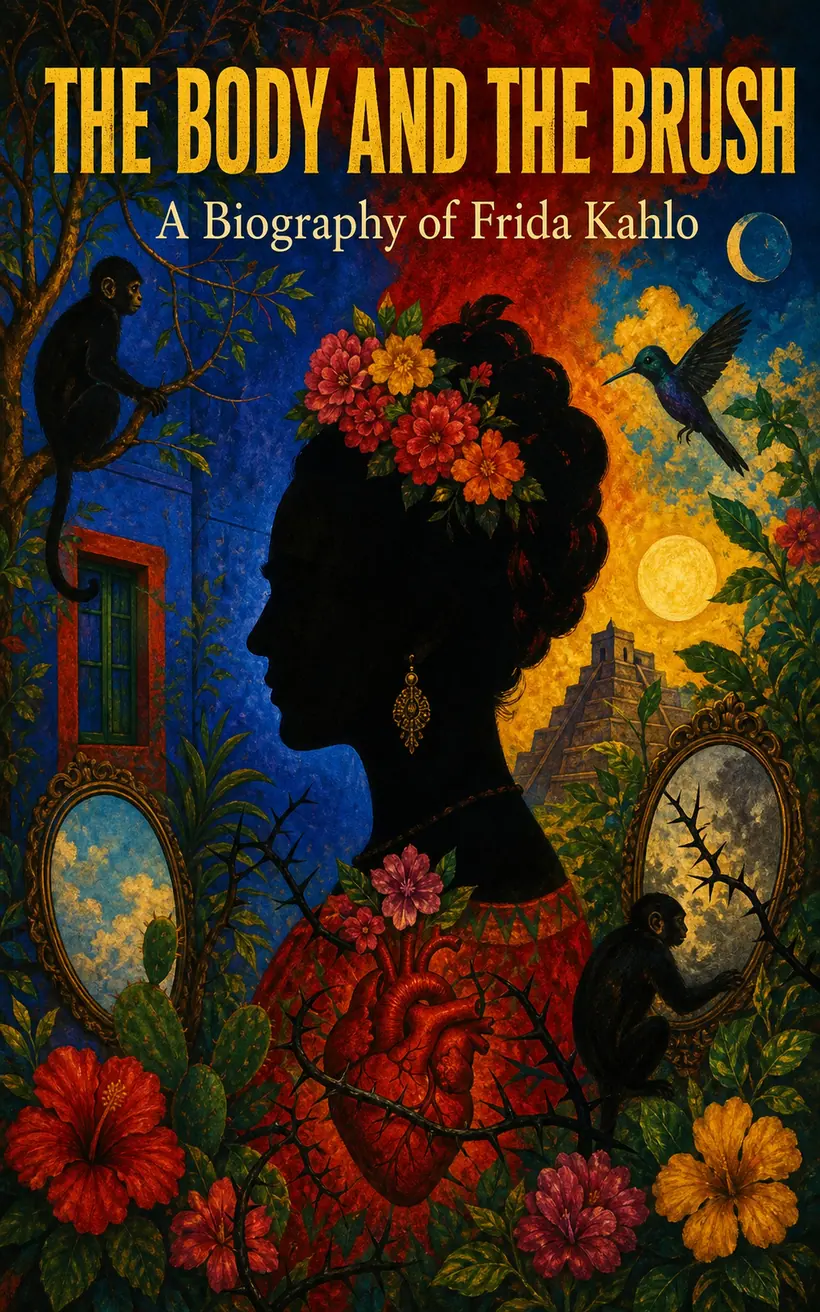
a biography of Magdalena Carmen Frida Kahlo y Calderón
On a September afternoon in 1925, a wooden bus collided with a streetcar in Mexico City. An eighteen-year-old art student named Magdalena Carmen Frida Kahlo y Calderón was impaled on a steel handrail. She would spend the next twenty-nine years rebuilding herself, in plaster, in paint, and in public.
Sofía Estrada's biography returns Kahlo to the rooms she actually inhabited: the blue house in Coyoacán, where polio first marked her body; the studios of Diego Rivera, whose marriage to her was at once a love affair and a political instrument; the guest quarters where Leon Trotsky took refuge, and where she took him as a lover. Estrada reads the paintings — fewer than two hundred in a working life — as documents of a woman who refused to look away from her own ruined spine, her miscarriages, her amputated leg.
Kahlo died in 1954, largely unknown outside a small circle. The face that now sells tote bags, tequila, and Halloween costumes is, in a sense, a second life — one she did not live to consent to. Estrada traces that afterlife with the same care she gives the original: the 1980s rediscovery, the academic canonization, the licensing wars, the brand.
What emerges is a portrait of a painter who built a self out of injury, and an industry that has been dismantling and reselling it ever since.
The opening chapter is published in full — read it here.
The printed edition has no ISBN registered yet. It affects library and retail listing, not your order.
Magdalena Carmen Frida Kahlo y Calderón. The title never carries the subject's name: it names one concrete thing out of the life — in this case The Body and the Brush — and the name goes on the line underneath.
No. No subject, estate, label or foundation had approval over the text, and none paid for a word of it. The cost of that independence is that no new interviews were conducted for the book; it is built from the public record, and it says on the page where a scene is reconstructed rather than documented.
Yes — the whole opening chapter and the writer's foreword, free and in full, with no email address and no account. That is 3,785 words of the book.
About 62,500 words, 18 chapters, 195 pages in the paperback.
6 × 9 in, 60# uncoated cream, black ink, perfect-bound paperback, matte laminate. Every title in the series uses the same specification, so they line up on a shelf.
Yes: chronic pain; suicide ideation. They are listed before you buy rather than discovered afterwards. The material is handled as evidence, not as spectacle.
Listed before you buy, not after.
Paperback · Hardcover
Paperback · Hardcover
Paperback