The Annina Nosei Gallery
Paperback · Hardcover
Download link emailed the moment payment clears.
3,655 words · no email, no account
No. 087 · Art & Design · Visual Art
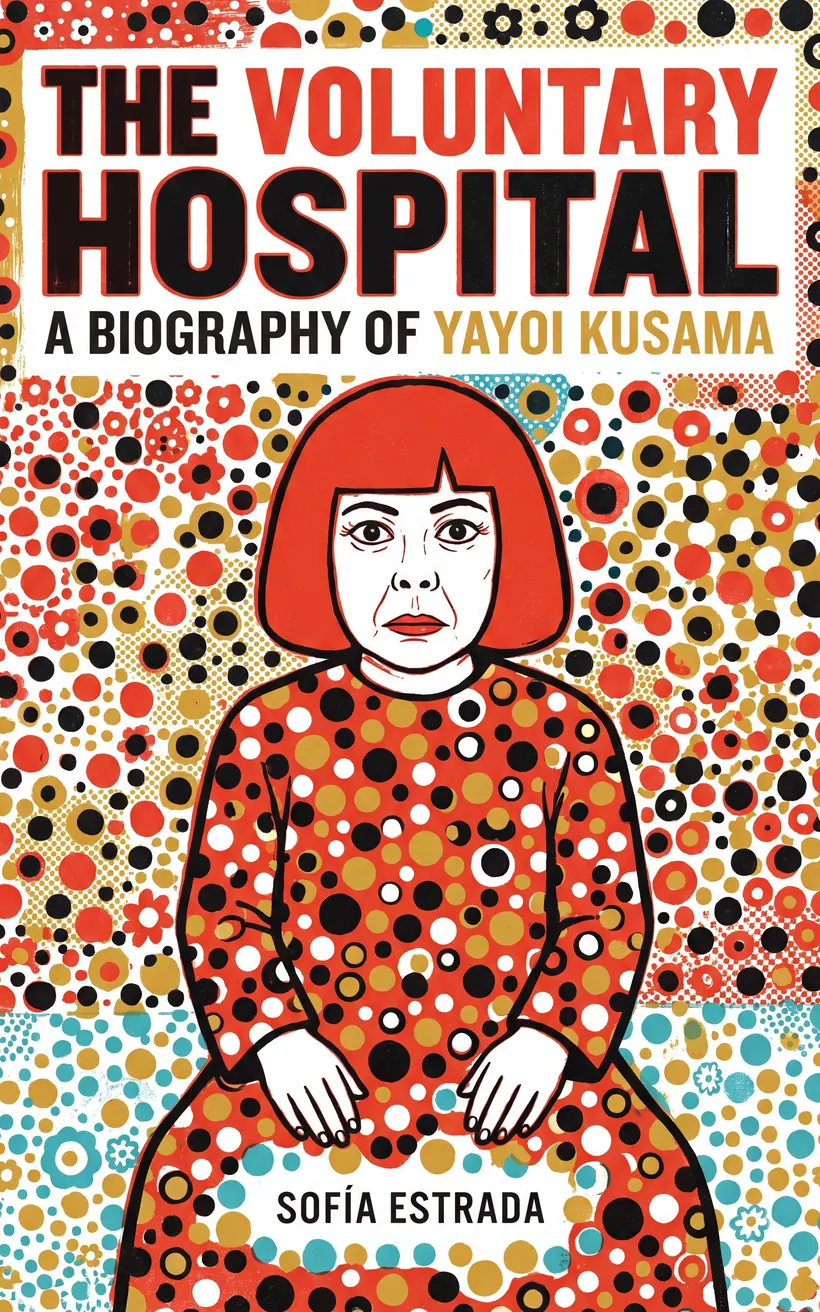
a biography of Yayoi Kusama
The Infinity Mirrors rooms pull queues. When the Hirshhorn hung the retrospective in 2017 it drew tens of thousands of visitors a week, and the polka dots and net patterns filling those rooms are the ones Yayoi Kusama began drawing at the age of ten.
She moved to New York in 1958 and lived poor on West 53rd Street. The net paintings went up at the Brata Gallery in 1959. She knew Donald Judd and Eva Hesse. By 1968 she was staging anti-Vietnam-War body-painting happenings on the Brooklyn Bridge and outside MoMA. In 1973 she went back to Tokyo, and in 1977 she admitted herself, voluntarily, to the Seiwa Hospital in Shinjuku. She has lived and worked there every day since.
Sofía Estrada's biography follows the whole line: the wartime childhood in Matsumoto, where she was born on March 22, 1929, the youngest daughter of a wealthy seedling-merchant family; the early hallucinations; the New York decade and its friendships; the late-sixties happenings; the return to Japan and the long hospitalisation; and the late-life turn that produced the mirror rooms, the 2017 Hirshhorn show, and the Yayoi Kusama Museum that opened in Tokyo the same year. She still walks into it every morning to paint.
The argument is plain enough. The hallucinations became the visual grammar of contemporary art, and a hospital window on Shinjuku has been, for nearly fifty years, the studio that produced it. Estrada treats the 1977 admission not as a collapse but as an arrangement Kusama made herself and has kept every day since, through the second half of a working life that has not stopped.
The opening chapter is published in full — read it here.
Yayoi Kusama. The title never carries the subject's name: it names one concrete thing out of the life — in this case The Voluntary Hospital — and the name goes on the line underneath.
No. No subject, estate, label or foundation had approval over the text, and none paid for a word of it. The cost of that independence is that no new interviews were conducted for the book; it is built from the public record, and it says on the page where a scene is reconstructed rather than documented.
Yes — the whole opening chapter and the writer's foreword, free and in full, with no email address and no account. That is 3,655 words of the book.
About 60,500 words, 18 chapters, 198 pages in the paperback.
Paperback · Hardcover
Paperback · Hardcover
Paperback