The Birkbeck Years
Paperback
Ships in 2 to 5 working days. Delivery quoted from your address at checkout.
4,724 words · no email, no account
No. 094 · Science · Science
a biography of Srinivasa Ramanujan Aiyangar
He was born Srinivasa Ramanujan Aiyangar on December 22, 1887, in Erode, Tamil Nadu, the eldest son of a Brahmin clerk in a sari shop. He failed out of Government College in Kumbakonam because he refused to study anything but mathematics. He worked as a clerk at the Madras Port Trust on a salary of 25 rupees a month. On January 16, 1913, at twenty-five, he sent a letter containing 120 theorems to G. H. Hardy at Trinity College, Cambridge. Hardy and his collaborator J. E. Littlewood spent three months working through the letter, decided the theorems were the work of a self-taught genius rather than a crank, and brought him to Cambridge in April 1914.
Ailsa Rennie's biography opens in Erode and follows the arc through the early visionary years in which a Madras Brahmin teenager in a tropical-textile-trade port city was deriving on his own most of the modular-forms and partition-theory results that the European mathematical community had taken Euler, Gauss, and Jacobi to produce. The book traces the Hardy correspondence, the 1914-1919 Cambridge years, the 1916 Fellowship of the Royal Society election at twenty-eight, the long tuberculous decline in English sanatoriums, the 1919 return to India, the eighty-three pages of the Lost Notebook that George Andrews found at Trinity in 1976 and that the field is still finishing, and the death at thirty-two on April 26, 1920.
What emerges is a portrait of the Madras port-trust clerk whose letter the Cambridge mathematical establishment took three months to read seriously, and whose results the field is, more than a century later, still finishing to prove.
The opening chapter is published in full — read it here.
The printed edition has no ISBN registered yet. It affects library and retail listing, not your order.
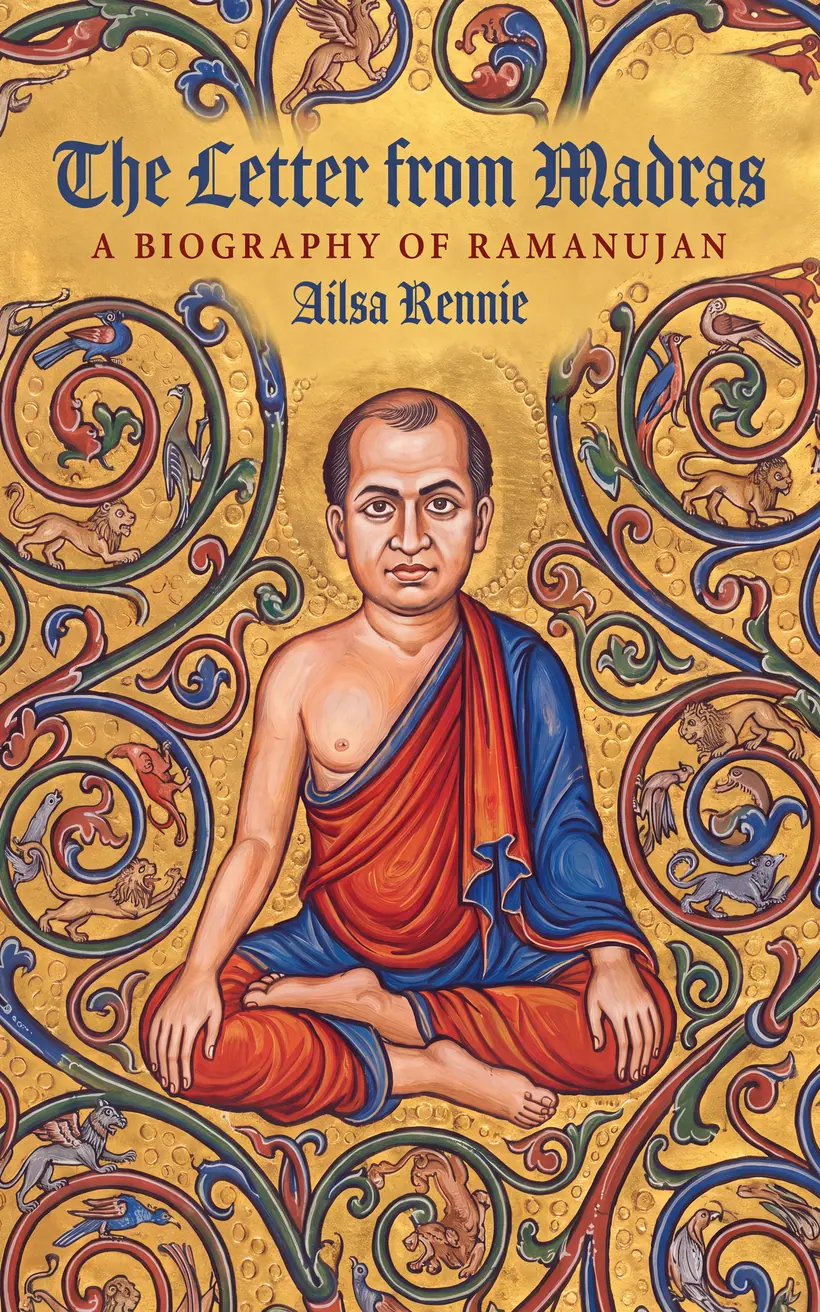
Srinivasa Ramanujan Aiyangar. The title never carries the subject's name: it names one concrete thing out of the life — in this case The Letter from Madras — and the name goes on the line underneath.
No. No subject, estate, label or foundation had approval over the text, and none paid for a word of it. The cost of that independence is that no new interviews were conducted for the book; it is built from the public record, and it says on the page where a scene is reconstructed rather than documented.
Yes — the whole opening chapter and the writer's foreword, free and in full, with no email address and no account. That is 4,724 words of the book.
About 64,000 words, 19 chapters, 212 pages in the paperback.
6 × 9 in, 60# uncoated cream, black ink, perfect-bound paperback, matte laminate. Every title in the series uses the same specification, so they line up on a shelf.