The Thirteen-Year Conservatorship
Paperback · Hardcover
Download link emailed the moment payment clears.
4,510 words · no email, no account
No. 138 · Music · Pop
a biography of Billie Eilish Pirate Baird O'Connell
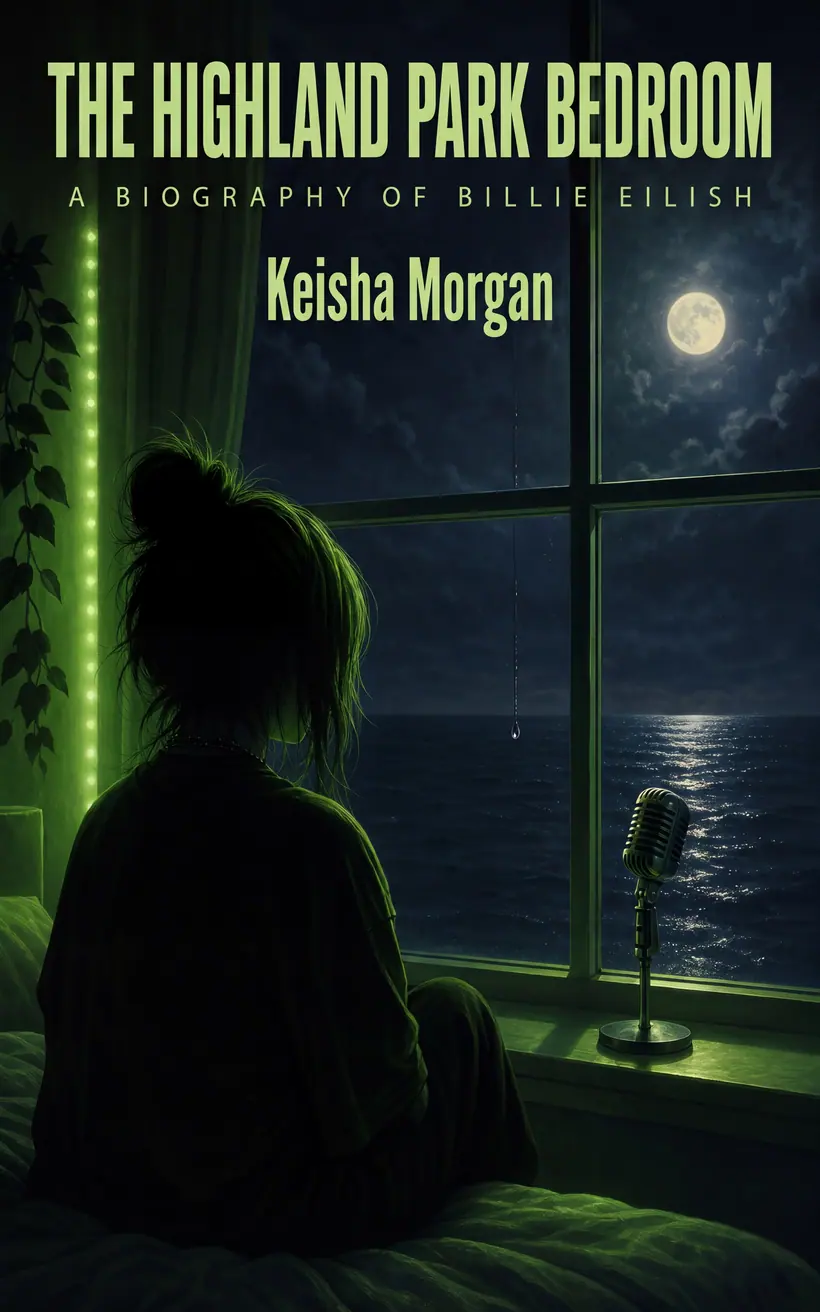
The request came from a dance teacher, who wanted a song she could choreograph. Billie Eilish and her brother Finneas O'Connell wrote Ocean Eyes in their childhood bedroom in 2015 and uploaded it to SoundCloud as a favour. What the favour cost was the room. A private place became the opening chapter of a public career, and it has been read back to her ever since.
When We All Fall Asleep, Where Do We Go? followed in March 2019. At the 62nd Grammy Awards in January 2020, voters handed an eighteen-year-old the Big Four — Best New Artist, Album of the Year, Record of the Year and Song of the Year — the first sweep of those categories since Christopher Cross in 1981. That was also a decision made about her rather than by her, and Keisha Morgan's biography treats it as one.
Morgan works from the Highland Park neighborhood of Los Angeles, where Eilish was born on December 18, 2001, the second child of Maggie Baird and Patrick O'Connell, two working actors, through the Tourette's diagnosis and the synaesthesia, the James Bond theme No Time to Die that won the 93rd Academy Award, the 2021 album Happier Than Ever and its Disney+ concert film, the documentary The World's a Little Blurry, the 106-date Hit Me Hard and Soft arena tour of 2024-25, and the sweep at the 67th Grammy Awards in early 2025.
What emerges is a portrait of a pop star raised by working actors and schooled at the kitchen table, whose hushed and whispered debut redrew the visual and sonic grammar of mainstream pop.
The opening chapter is published in full — read it here.
Billie Eilish Pirate Baird O'Connell. The title never carries the subject's name: it names one concrete thing out of the life — in this case The Highland Park Bedroom — and the name goes on the line underneath.
No. No subject, estate, label or foundation had approval over the text, and none paid for a word of it. The cost of that independence is that no new interviews were conducted for the book; it is built from the public record, and it says on the page where a scene is reconstructed rather than documented.
Yes — the whole opening chapter and the writer's foreword, free and in full, with no email address and no account. That is 4,510 words of the book.
About 61,000 words, 19 chapters, 200 pages in the paperback.
Yes: self-harm; depression. They are listed before you buy rather than discovered afterwards. The material is handled as evidence, not as spectacle.
Listed before you buy, not after.
Paperback · Hardcover
Digital edition
Paperback