The Opening
Paperback
Ships in 2 to 5 working days. Delivery quoted from your address at checkout.
2,911 words · no email, no account
No. 193 · Power & Politics · History
a biography of Cleopatra VII Philopator
August 30 BCE, the royal mausoleum on the eastern harbour of Alexandria. Cleopatra VII Philopator, thirty-nine, the last ruler of the Ptolemaic Kingdom of Egypt, dies — by tradition from the bite of an Egyptian cobra she has placed against her chest, by Plutarch's more sceptical reading from a poison smuggled into her chamber in a basket of figs. Octavian, the future Augustus, has taken Alexandria nine days earlier. Mark Antony has died in her arms in the same mausoleum after having stabbed himself with his own sword. The kingdom that her ancestor Ptolemy I Soter had founded in 305 BCE — three centuries less six weeks — ends with her.
Edward Forrester's biography opens earlier — in Alexandria, where Cleopatra was born in 70 or 69 BCE, the third child of Ptolemy XII Auletes — and follows the arc through the Mouseion library education and the multi-language facility she alone of her dynasty acquired, the 51 BCE accession with her younger brother-husband Ptolemy XIII, the 48 BCE Pompey killing and the Caesar arrival, the 47 BCE Alexandrian War and the Caesarion birth, the 44 BCE Caesar assassination and the return to Egypt, the 41 BCE Tarsus summit with Antony, the Donations of Alexandria of 34 BCE, the 31 BCE Actium naval defeat, and the August 30 BCE Alexandrian endgame.
What emerges is a portrait of the last and most studied of the Ptolemies — and the Schiff-register documentary reconstruction her life has rewarded for two thousand years.
The opening chapter is published in full — read it here.
The printed edition has no ISBN registered yet. It affects library and retail listing, not your order.
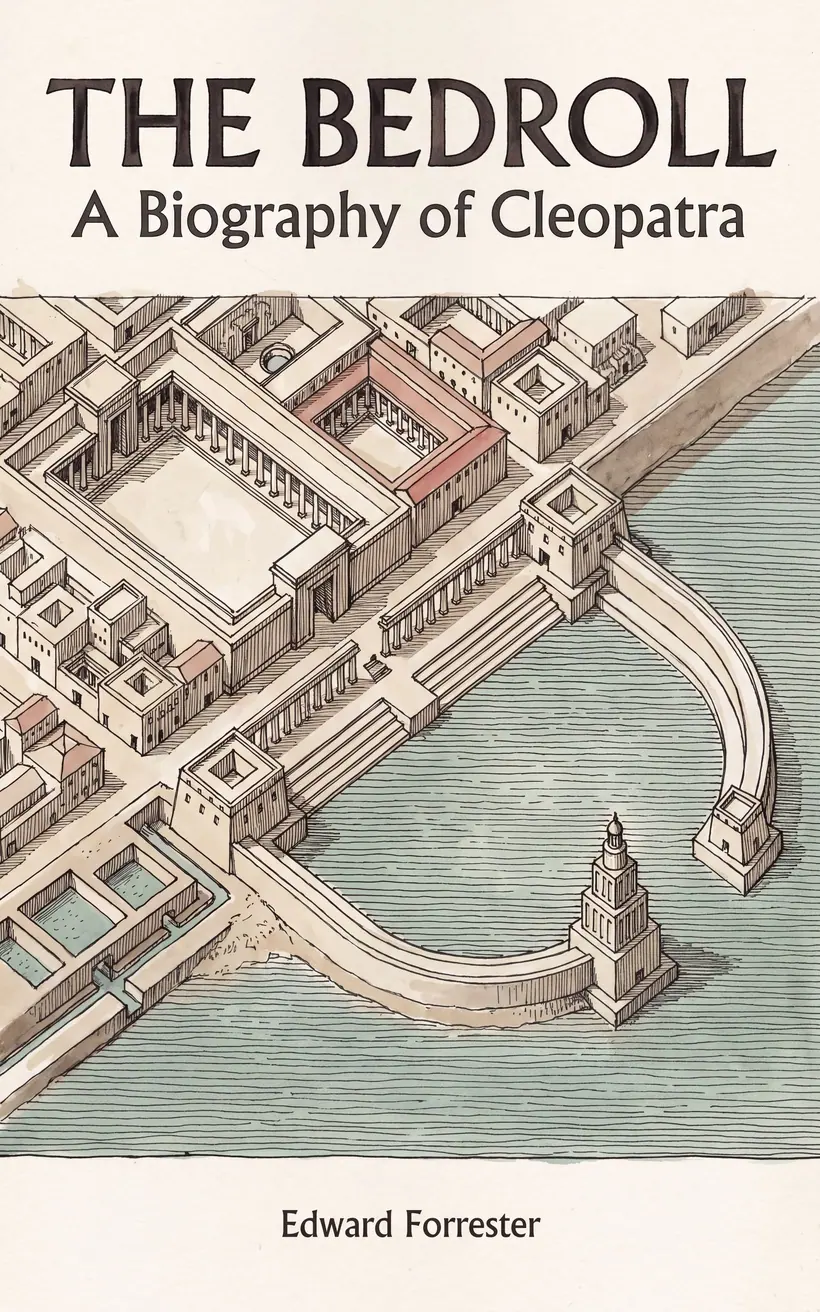
Cleopatra VII Philopator. The title never carries the subject's name: it names one concrete thing out of the life — in this case The Bedroll — and the name goes on the line underneath.
No. No subject, estate, label or foundation had approval over the text, and none paid for a word of it. The cost of that independence is that no new interviews were conducted for the book; it is built from the public record, and it says on the page where a scene is reconstructed rather than documented.
Yes — the whole opening chapter and the writer's foreword, free and in full, with no email address and no account. That is 2,911 words of the book.
About 60,000 words, 18 chapters, 201 pages in the paperback.
6 × 9 in, 60# uncoated cream, black ink, perfect-bound paperback, matte laminate. Every title in the series uses the same specification, so they line up on a shelf.