The Opening
Paperback
Ships in 2 to 5 working days. Delivery quoted from your address at checkout.
2,915 words · no email, no account
No. 194 · Power & Politics · History
a biography of Temüjin (Genghis Khan)
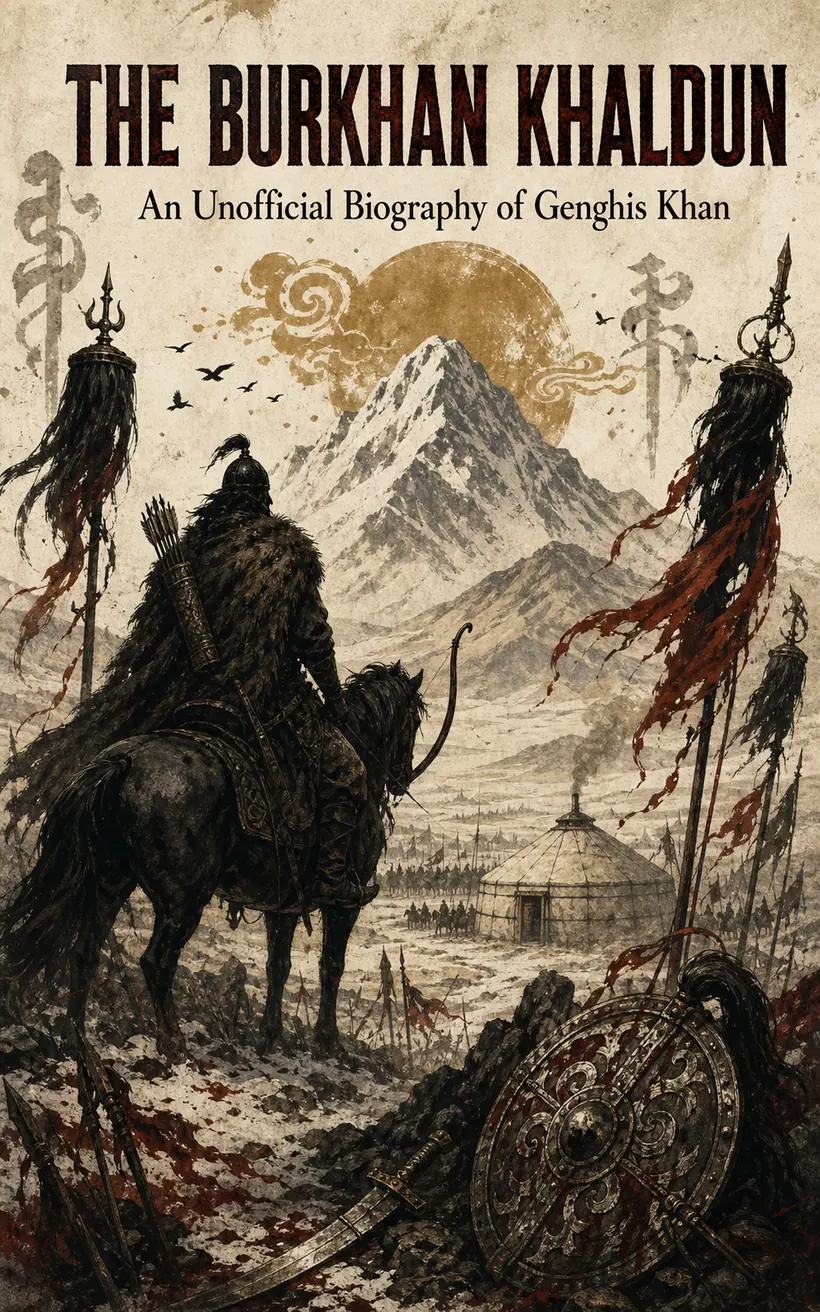
August 1227, the Liupan Mountains of what is now Ningxia, China. Temüjin, around sixty, the Mongol khan who has spent the past twenty-one years building the largest contiguous land empire in human history, dies on campaign against the Western Xia. The cause is unclear: a fall from a horse the previous winter, an infected arrow wound from the Tangut siege, malaria, or — in the more sensational sources — the knife of a Tangut princess he had taken as a concubine. His body is returned to the Burkhan Khaldun mountain in northeastern Mongolia for burial in a secret tomb that has never been found.
Edward Forrester's biography opens earlier — at the Onon River, where Temüjin was born around 1162, the eldest son of the Borjigin chief Yesügei — and follows the arc through the poisoning of Yesügei when Temüjin was eight, the long flight with his widowed mother Hoelun and his brothers Khasar and Begter, the killing of Begter, the early years of vassalage and the long Jamukha-anda blood-brotherhood and breach, the 1206 kurultai at which Temüjin was given the title Chinggis Khan, the long Western Xia and Jin and Khwarazmian campaigns, the 1219-1222 Khwarazmian destruction, the 1227 Western Xia second campaign, and the Yelü-trained-administration that survived him through the Yuan dynasty.
What emerges is a portrait of the founder of the largest contiguous empire in human history — and the historiographical debates the Mongol-conquest scholarship has spent eight hundred years working out how to write.
The opening chapter is published in full — read it here.
The printed edition has no ISBN registered yet. It affects library and retail listing, not your order.
Temüjin (Genghis Khan). The title never carries the subject's name: it names one concrete thing out of the life — in this case The Burkhan Khaldun — and the name goes on the line underneath.
No. No subject, estate, label or foundation had approval over the text, and none paid for a word of it. The cost of that independence is that no new interviews were conducted for the book; it is built from the public record, and it says on the page where a scene is reconstructed rather than documented.
Yes — the whole opening chapter and the writer's foreword, free and in full, with no email address and no account. That is 2,915 words of the book.
About 64,000 words, 18 chapters, 225 pages in the paperback.
6 × 9 in, 60# uncoated cream, black ink, perfect-bound paperback, matte laminate. Every title in the series uses the same specification, so they line up on a shelf.
Yes: mass violence; sexual violence. They are listed before you buy rather than discovered afterwards. The material is handled as evidence, not as spectacle.
Listed before you buy, not after.