The Opening
Paperback
Ships in 2 to 5 working days. Delivery quoted from your address at checkout.
2,593 words · no email, no account
No. 195 · Power & Politics · History
a biography of Napoleon Bonaparte (born Napoleone Buonaparte)
May 5, 1821, the Longwood estate on the island of Saint Helena, two thousand nine hundred kilometres from the nearest Brazilian coast. Napoleon Bonaparte, fifty-one, dies of stomach cancer in the bedroom that has been his prison since October 1815. Five years and six months earlier he had surrendered to the captain of HMS Bellerophon off the coast of Rochefort. His autopsy is performed by the British physician Dr. Francesco Antommarchi. He is buried in the Sane Valley below Longwood. His body is repatriated to the Invalides in Paris on December 15, 1840.
Edward Forrester's biography opens earlier — in Ajaccio, Corsica, where Napoleone Buonaparte was born on August 15, 1769, the fourth child of Carlo and Letizia (after two infants who had died and the future king of Naples Joseph) — and follows the arc through the École Royale Militaire de Brienne and the École Militaire de Paris years, the 1789 Revolution and the long Italian Campaign of 1796-97, the 1799 Brumaire coup, the long Consulate and the 1804 imperial coronation, the long 1805-1812 zenith of Austerlitz and Jena and Friedland and Wagram, the 1812 Russian disaster, the 1814 abdication and the Elba exile, the 1815 Hundred Days and Waterloo, and the long Longwood imprisonment.
What emerges is a portrait of the Ajaccio-born Corsican junior officer whose fifteen years of military command redrew the political map of Europe — and the British-prison-island death the post-Vienna Congress arranged.
The opening chapter is published in full — read it here.
The printed edition has no ISBN registered yet. It affects library and retail listing, not your order.
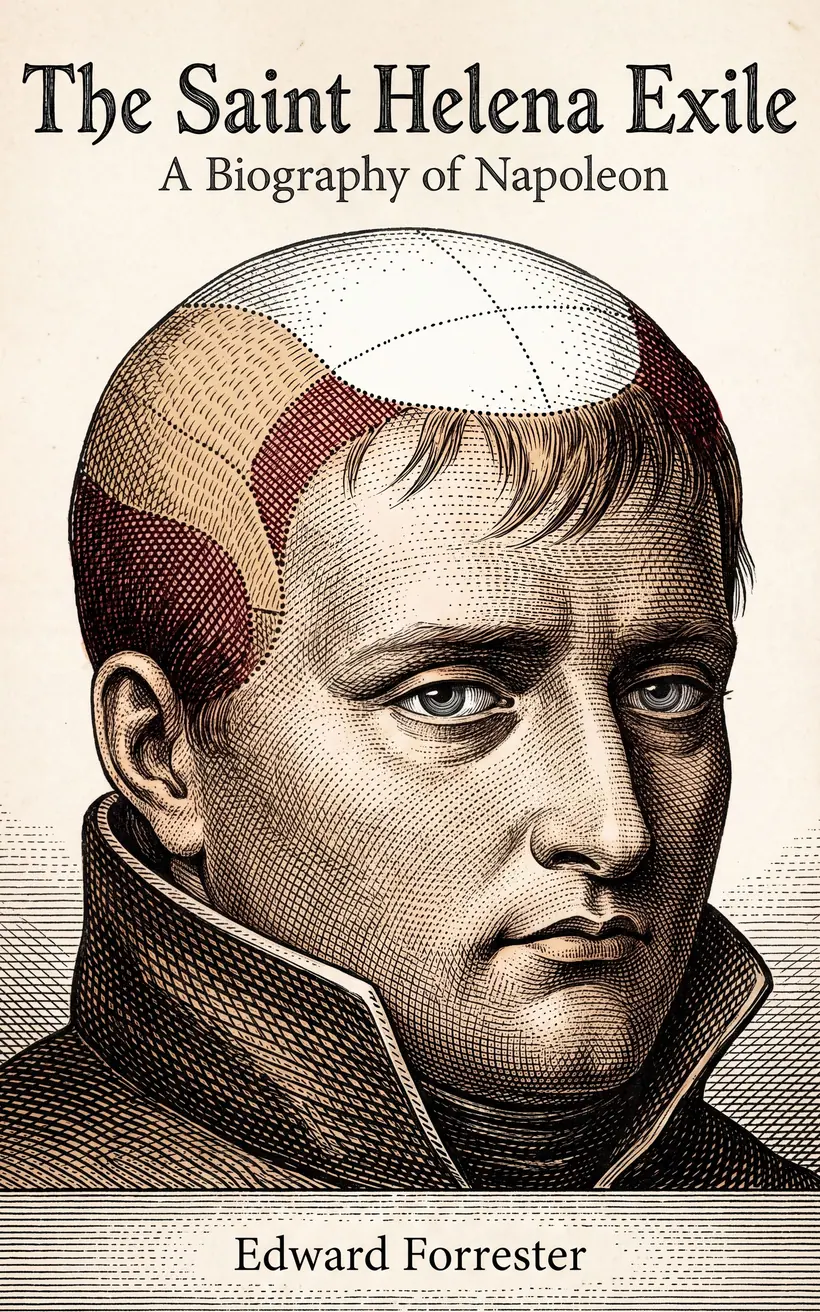
Napoleon Bonaparte (born Napoleone Buonaparte). The title never carries the subject's name: it names one concrete thing out of the life — in this case The Saint Helena Exile — and the name goes on the line underneath.
No. No subject, estate, label or foundation had approval over the text, and none paid for a word of it. The cost of that independence is that no new interviews were conducted for the book; it is built from the public record, and it says on the page where a scene is reconstructed rather than documented.
Yes — the whole opening chapter and the writer's foreword, free and in full, with no email address and no account. That is 2,593 words of the book.
About 68,500 words, 19 chapters, 258 pages in the paperback.
6 × 9 in, 60# uncoated cream, black ink, perfect-bound paperback, matte laminate. Every title in the series uses the same specification, so they line up on a shelf.