The USC Film School
Paperback
Download link emailed the moment payment clears.
2,175 words · no email, no account
No. 216 · Screen & Stage · Film
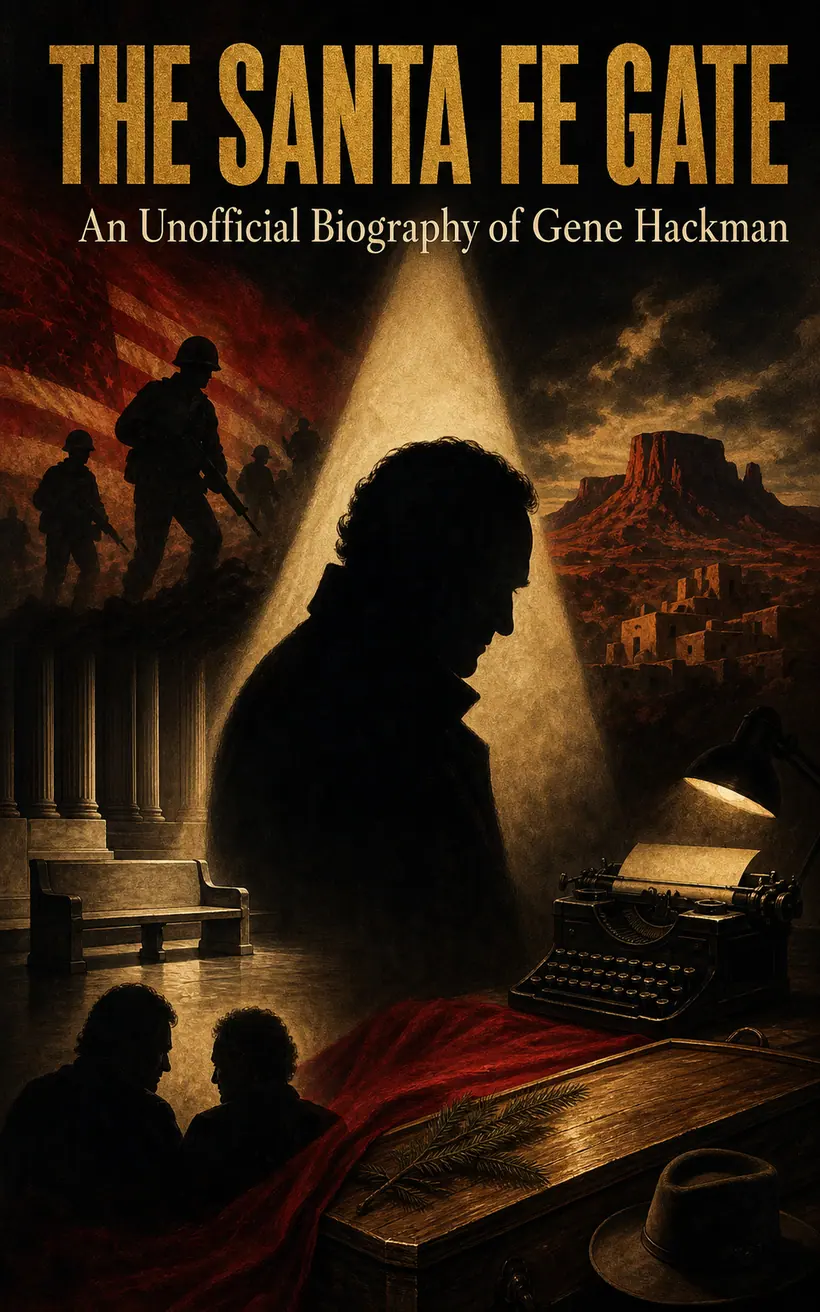
a biography of Eugene Allen Hackman
February 26, 2025. Sheriff's deputies enter the Santa Fe gate of the property at the end of an unmarked Tesuque, New Mexico road that Gene Hackman and his wife Betsy Arakawa have lived on since 2003. They find Hackman, ninety-five, dead in his kitchen. They find Arakawa, sixty-five, dead in a bathroom off the home's master suite. The medical examiner will rule Arakawa's death from hantavirus pulmonary syndrome — contracted from the rodent droppings in the property's outbuildings — preceded Hackman's by approximately a week. Hackman, who had been diagnosed with Alzheimer's disease in the early 2020s, had been alone with his wife's body for that week. His own death was cardiovascular.
Donovan Hadley's biography opens earlier — in San Bernardino, California, where Eugene Allen Hackman was born on January 30, 1930, the elder of two sons of a printer and a homemaker — and follows the arc through the Danville, Illinois move and the long childhood with the father who left for the Saturday matinee one afternoon in 1943 and never returned, the 1946 U.S. Marine Corps enlistment at sixteen on a forged date-of-birth document, the long Pasadena Playhouse years, the 1967 Bonnie and Clyde breakthrough at thirty-seven, the 1971 Academy Award for The French Connection, the 1974 Conversation and the 1978 Superman, the 1992 Academy Award for Unforgiven, the 2001 Royal Tenenbaums, the 2004 retirement after Welcome to Mooseport, the 1986 Betsy Arakawa relationship and the 1991 marriage, the four novels and the long Tesuque retirement, and the February 2025 Santa Fe property.
What emerges is a portrait of the San Bernardino printer's son who served as a Marine at sixteen, broke into Hollywood at thirty-seven, won two Academy Awards, and lived a quarter-century retirement on a Tesuque arroyo where the final week of his life passed without anyone knowing.
The opening chapter is published in full — read it here.
Eugene Allen Hackman. The title never carries the subject's name: it names one concrete thing out of the life — in this case The Santa Fe Gate — and the name goes on the line underneath.
No. No subject, estate, label or foundation had approval over the text, and none paid for a word of it. The cost of that independence is that no new interviews were conducted for the book; it is built from the public record, and it says on the page where a scene is reconstructed rather than documented.
Yes — the whole opening chapter and the writer's foreword, free and in full, with no email address and no account. That is 2,175 words of the book.
About 59,000 words, 18 chapters, 194 pages in the paperback.