The Birkbeck Years
Paperback
Ships in 2 to 5 working days. Delivery quoted from your address at checkout.
3,992 words · no email, no account
No. 222 · Science · Science
a biography of Stephen William Hawking
Cambridge, 1965. A twenty-three-year-old graduate student delivers a viva voce defence of his thesis on the singularity theorems while holding the lectern with both hands to keep upright. The motor-neurone diagnosis is two and a half years old. The internal examiner's report calls the work "the most extraordinary doctoral submission this committee has examined." The next year, the thesis becomes a Cambridge fellowship.
Eleanor Whitlock follows Stephen Hawking from that viva to the synthesizer voice — through the work on cosmological singularities, the 1974 paper that black holes are not in fact black, the bet with Kip Thorne (paid out, in 1990, in a year's subscription to Penthouse), the divorce, the second marriage, the second divorce, the public-intellectual phase that A Brief History of Time made possible and that the family later said they regretted.
Drawing on the DAMTP archive, Hawking's working papers, the technical correspondence with Bekenstein and Penrose, and conversations with the graduate students he supervised, Hartwell refuses the inspirational-overcomer framing in favour of the work itself. What emerges is a study of theoretical physics in the late twentieth century, of a man who measured his own life by the equations he had not yet finished, and of the cost — to his marriages, his children, and his body — of refusing to slow down.
The opening chapter is published in full — read it here.
The printed edition has no ISBN registered yet. It affects library and retail listing, not your order.
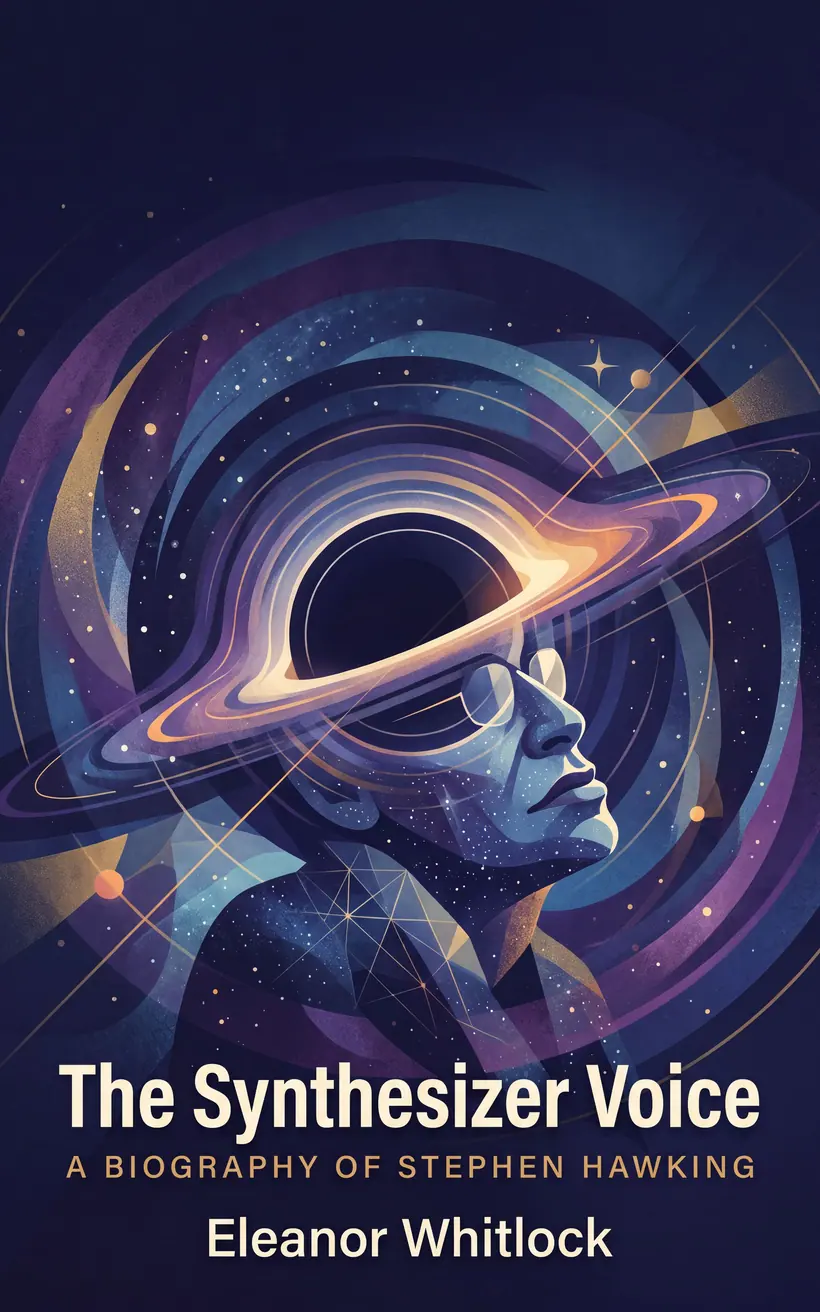
Stephen William Hawking. The title never carries the subject's name: it names one concrete thing out of the life — in this case The Synthesizer Voice — and the name goes on the line underneath.
No. No subject, estate, label or foundation had approval over the text, and none paid for a word of it. The cost of that independence is that no new interviews were conducted for the book; it is built from the public record, and it says on the page where a scene is reconstructed rather than documented.
Yes — the whole opening chapter and the writer's foreword, free and in full, with no email address and no account. That is 3,992 words of the book.
About 64,000 words, 18 chapters, 196 pages in the paperback.
6 × 9 in, 60# uncoated cream, black ink, perfect-bound paperback, matte laminate. Every title in the series uses the same specification, so they line up on a shelf.