The USC Film School
Paperback
Download link emailed the moment payment clears.
4,862 words · no email, no account
No. 233 · Screen & Stage · Film
a biography of Federico Fellini
The Cinema Fulgor, Rimini, 1926: a Maciste serial running on the screen, and somewhere in the dark the eldest of three children of a Romagnese travelling salesman and a Roman shopkeeper's daughter. Federico Fellini had been born in that town on the Adriatic coast on January 20, 1920. At nineteen he left it for Rome and drew caricatures for the satirical magazine Marc'Aurelio.
The films came out of that. He co-wrote Roberto Rossellini's Rome, Open City (1945) and Paisan (1946), the foundational films of Italian neorealism, and then directed I Vitelloni (1953), La Strada (1954, with his wife Giulietta Masina), La Dolce Vita (1960), 8½ (1963), Amarcord (1973) and Ginger and Fred (1986). Five Academy Awards followed: four for Best Foreign Language Film, and an Honorary Oscar in 1993. The Palme d'Or at Cannes went to La Dolce Vita in 1960. He suffered a stroke on August 3, 1993, and a second on October 17, and died at the Policlinico Umberto I in Rome on October 31, at seventy-three. Giulietta Masina died of lung cancer on March 23, 1994.
Donovan Hadley's biography opens earlier and follows the arc with the documentary patience the work rewards: the Rimini childhood and the Fulgor; the Marc'Aurelio satirical years and the early Rossellini collaborations; the long screenwriting partnerships with Pier Paolo Pasolini, Tonino Guerra and Bernardino Zapponi; the Cinecittà Studios years and the Nino Rota scores; La Dolce Vita as the cultural event of 1960; the meta-cinema of 8½ in 1963; the reception of the late Casanova (1976) and And the Ship Sails On (1983); the Pomodoro sepulchre at the Cimitero Monumentale di Rimini; and the funeral, with Masina and the trumpet of Improvviso dell'Angelo.
What emerges is a portrait of a forty-year career that became the foundational body of post-neorealist European cinema, and of a marriage to Giulietta Masina that ran the entire fifty years of it.
The opening chapter is published in full — read it here.
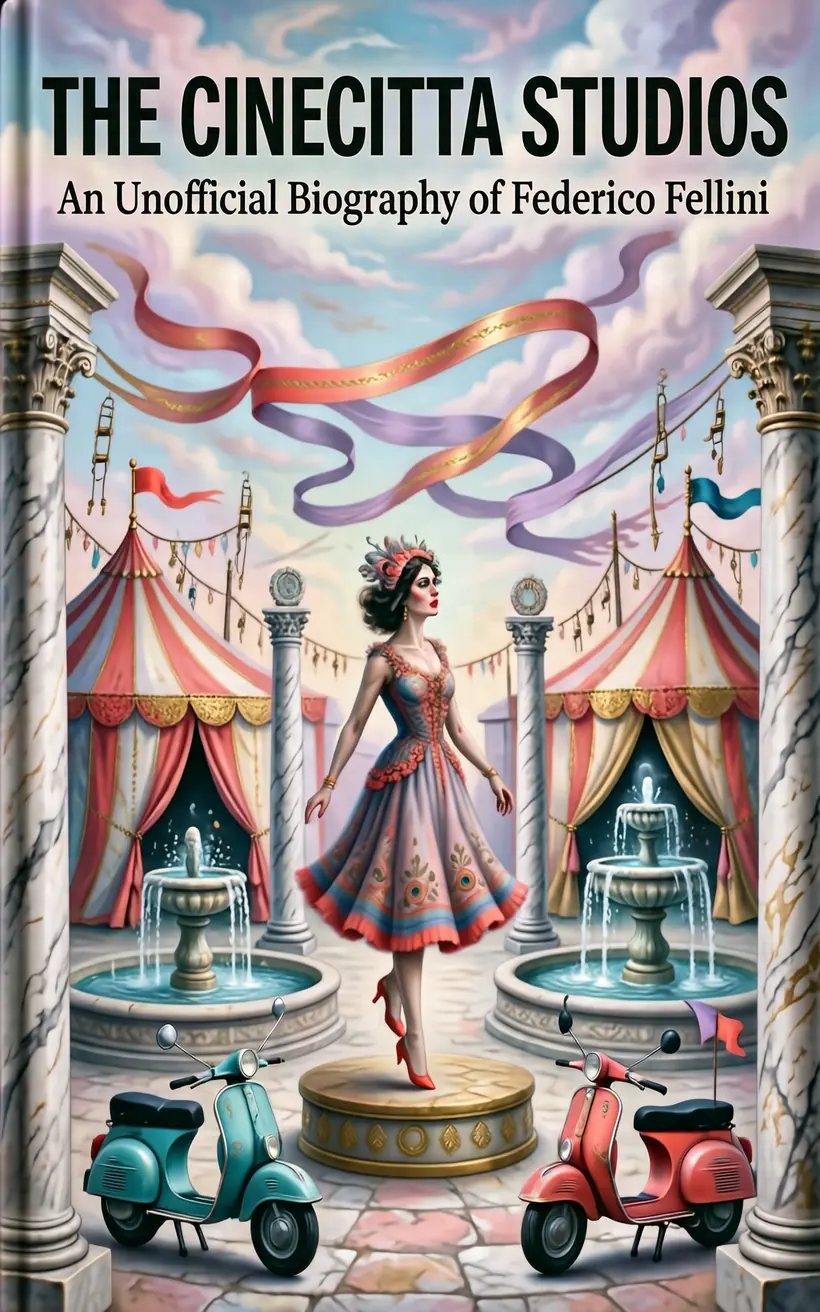
Federico Fellini. The title never carries the subject's name: it names one concrete thing out of the life — in this case The Cinecitta Studios — and the name goes on the line underneath.
No. No subject, estate, label or foundation had approval over the text, and none paid for a word of it. The cost of that independence is that no new interviews were conducted for the book; it is built from the public record, and it says on the page where a scene is reconstructed rather than documented.
Yes — the whole opening chapter and the writer's foreword, free and in full, with no email address and no account. That is 4,862 words of the book.
About 61,500 words, 24 chapters, 202 pages in the paperback.