The Castro Camera Storefront
Paperback · Hardcover
Download link emailed the moment payment clears.
4,667 words · no email, no account
No. 239 · Power & Politics · American Politics
a biography of Andrew Jackson
In February 1825 the House of Representatives handed the presidency to another man, and Andrew Jackson spent the rest of his life collecting on it. He was elected in 1828, re-elected in 1832, and left office in 1837. By then he had signed the Indian Removal Act, concluded roughly seventy removal treaties, and presided over the deportation of approximately fifty thousand people.
He came out of the Waxhaws, on the unsurveyed Carolina border. The Revolution killed his mother and both his brothers before he was fifteen. He destroyed the Red Stick Creeks at Horseshoe Bend in 1814 and dictated the Treaty of Fort Jackson, which took some twenty-three million acres. He beat the British at New Orleans in 1815 and invaded Spanish Florida in 1818 without orders. He has been on the twenty-dollar bill since 1928.
This book holds two records in parallel columns and refuses to bridge them. Jackson genuinely enlarged American democracy: he destroyed the congressional caucus, established the popular mandate as the ground of presidential authority, and in the Bank veto of July 1832 wrote the most powerful statement against oligarchy ever issued over an American president's signature. These were not two careers. The veto and the removal message of December 1830 rest on the same majoritarian premise. The first expands the circle of membership downward to the farmer and the labourer; the second establishes where that circle stops.
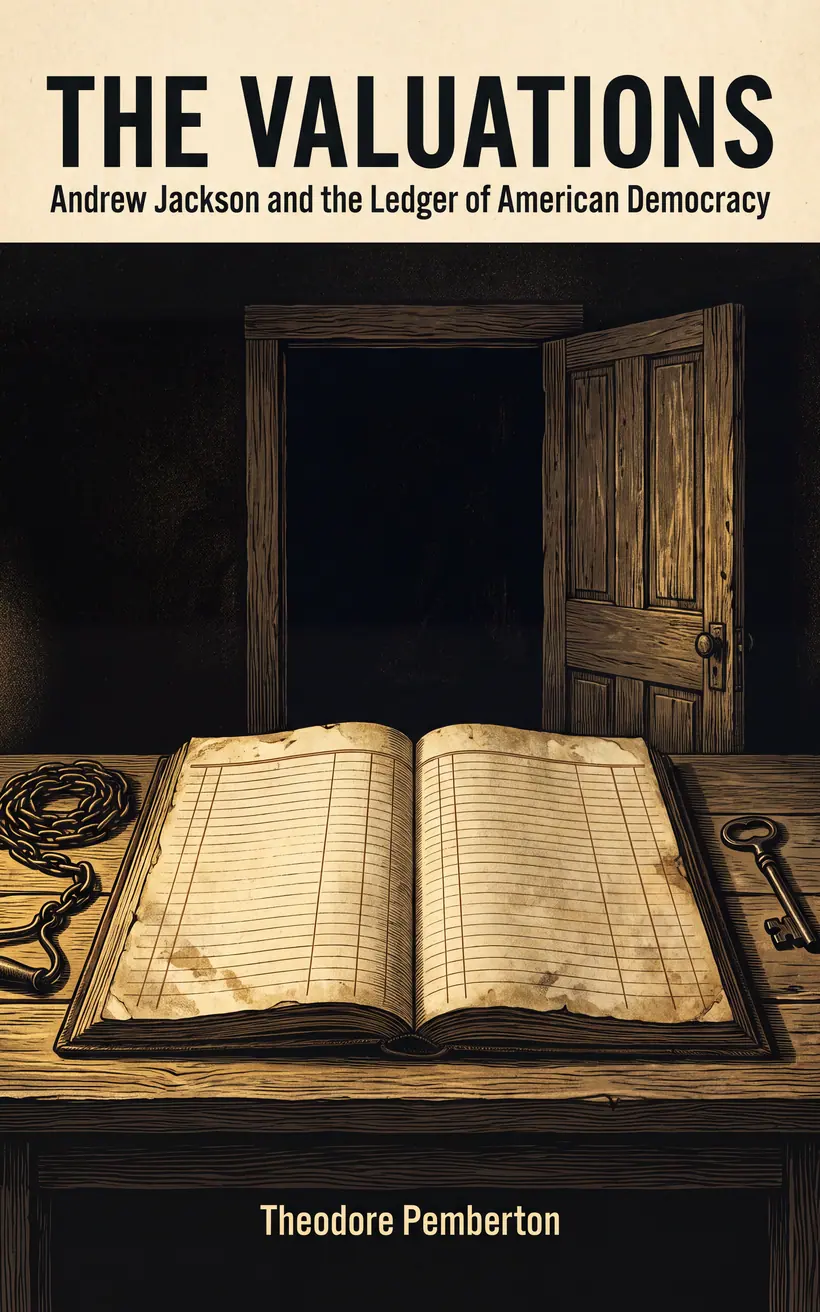
Twenty-one chapters stay close to the documents, and the last of them explains the title. In 1836 appraisers walked through the Cherokee Nation pricing every dwelling, fish trap and fruit tree; roughly sixteen thousand people appear in that record by name. Against it stand the other columns: twenty-five million acres opened to cotton, and the enslaved population of Mississippi nearly tripled in ten years. One Army invoice covers lumber for four hundred and sixty-nine coffins in eight weeks at a single post. No list of the dead was ever kept.
The opening chapter is published in full — read it here.
Andrew Jackson. The title never carries the subject's name: it names one concrete thing out of the life — in this case The Valuations — and the name goes on the line underneath.
No. No subject, estate, label or foundation had approval over the text, and none paid for a word of it. The cost of that independence is that no new interviews were conducted for the book; it is built from the public record, and it says on the page where a scene is reconstructed rather than documented.
Yes — the whole opening chapter and the writer's foreword, free and in full, with no email address and no account. That is 4,667 words of the book.
About 52,000 words, 21 chapters, 172 pages in the paperback.