The Opening
Paperback
Download link emailed the moment payment clears.
4,277 words · no email, no account
No. 275 · Power & Politics · History
a biography of Roald Engelbregt Gravning Amundsen
Hjalmar Johansen told the whole party that the leader had abandoned his men. Was he right? Roald Amundsen had started for the Pole on the first day the thermometer lifted to minus twenty-seven, too early, because he could not stop thinking about Scott. Within days it was minus fifty-eight, and Kristian Prestrud would have died on the Barrier if Johansen had not turned back for him. Johansen was removed from the polar party, placed under the command of the young lieutenant he had saved, reported to Nansen, paid off at Hobart and written out of the published account. He shot himself in Christiania in January 1913.
The book's argument is that the South Pole was not won in Antarctica. It was won in a harbour on King William Island six years earlier, where a Norwegian sea captain in a converted herring sloop spent two winters iced in at a place his hosts called Uqsuqtuuq, and the Netsilingmiut taught him dog-driving, snow houses, furs cut loose so that sweat can escape, and what to eat. Everything the British afterwards called cheating was the accumulated technology of people who had solved the problem centuries earlier. Seven of the twenty-one chapters happen before Antarctica; the Pole arrives in Chapter 15.
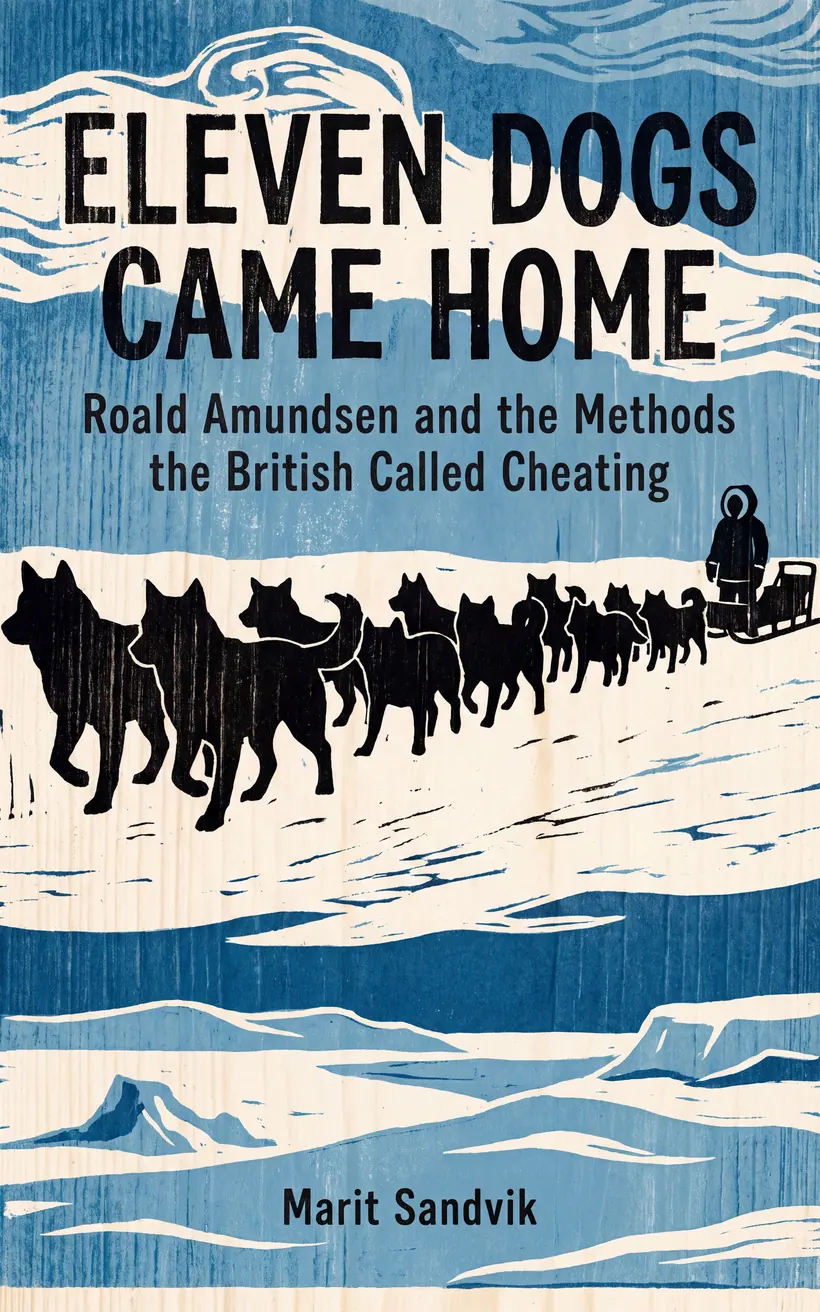
Five men, four sledges and fifty-two dogs left the Bay of Whales in October 1911. They came in to Framheim at four in the morning on 25 January 1912 with two sledges and eleven dogs, roughly 1,860 nautical miles, ten days inside a schedule written before anyone had seen the mountains. Nobody was lost and nobody got scurvy. Forty-five dogs stood in the traces at the top of the Axel Heiberg Glacier and eighteen were alive to pull the next day; the killing had been decided in Norway two years earlier, costed in calories. Five chapters are held back for the sixteen years afterwards, ending with a flight out of Tromsø in 1928 to look for the rival he had spent two years insulting. There is no death scene, because there is not enough evidence for one.
The opening chapter is published in full — read it here.
Roald Engelbregt Gravning Amundsen. The title never carries the subject's name: it names one concrete thing out of the life — in this case Eleven Dogs Came Home — and the name goes on the line underneath.
No. No subject, estate, label or foundation had approval over the text, and none paid for a word of it. The cost of that independence is that no new interviews were conducted for the book; it is built from the public record, and it says on the page where a scene is reconstructed rather than documented.
Yes — the whole opening chapter and the writer's foreword, free and in full, with no email address and no account. That is 4,277 words of the book.
About 68,500 words, 21 chapters, 222 pages in the paperback.