The Birkbeck Years
Paperback
Download link emailed the moment payment clears.
4,084 words · no email, no account
No. 280 · Science · Science
a biography of Fritz Jakob Haber
In the letter of resignation he wrote that for forty years he had chosen his collaborators by their intelligence and their character and not by their grandmothers. The Civil Service Law of April 1933 required the dismissal of Jewish employees. Fritz Haber, a decorated front-line officer, was personally exempt. His staff were not, and he would not draw up the list. It is the closest thing to a reckoning in the record, and it is not one: nowhere is there a retraction.
Almost every account is built on a hinge: the benefactor of humanity, then the war criminal. This book argues one act. In a Karlsruhe laboratory in 1909 an apparatus built by Robert Le Rossignol dripped liquid ammonia at roughly 125 millilitres an hour; four years later the works at Oppau opened, and within a year it made twenty tonnes a day. Roughly half the nitrogen atoms in a living human body arrived there through that reaction. North of Ypres on 22 April 1915, some 5,730 cylinders holding about 168 long tons of chlorine were opened into the French line at five in the afternoon, and the man who had worked the reaction out stood there to watch. Same laboratory, same method, same conviction, stated all his life: in peacetime a scientist belongs to the world, in war to his country. When the Royal Navy closed the sea lanes in 1914, Haber and Carl Bosch converted the ammonia capacity to munitions. Without that the war ends inside a year.
One chapter is quieter. Clara Immerwahr took a doctorate at Breslau in 1900, the first the university awarded a woman, and stopped doing science when she married. On the night of 1-2 May 1915, in the garden at Dahlem, she shot herself with her husband's service pistol, and their twelve-year-old son reached her first. Haber left for the Eastern Front the next morning. No note is known to survive, two readings circulate, and the book settles neither. He died in a Basel hotel in January 1934, at sixty-five, and the account does not balance.
The opening chapter is published in full — read it here.
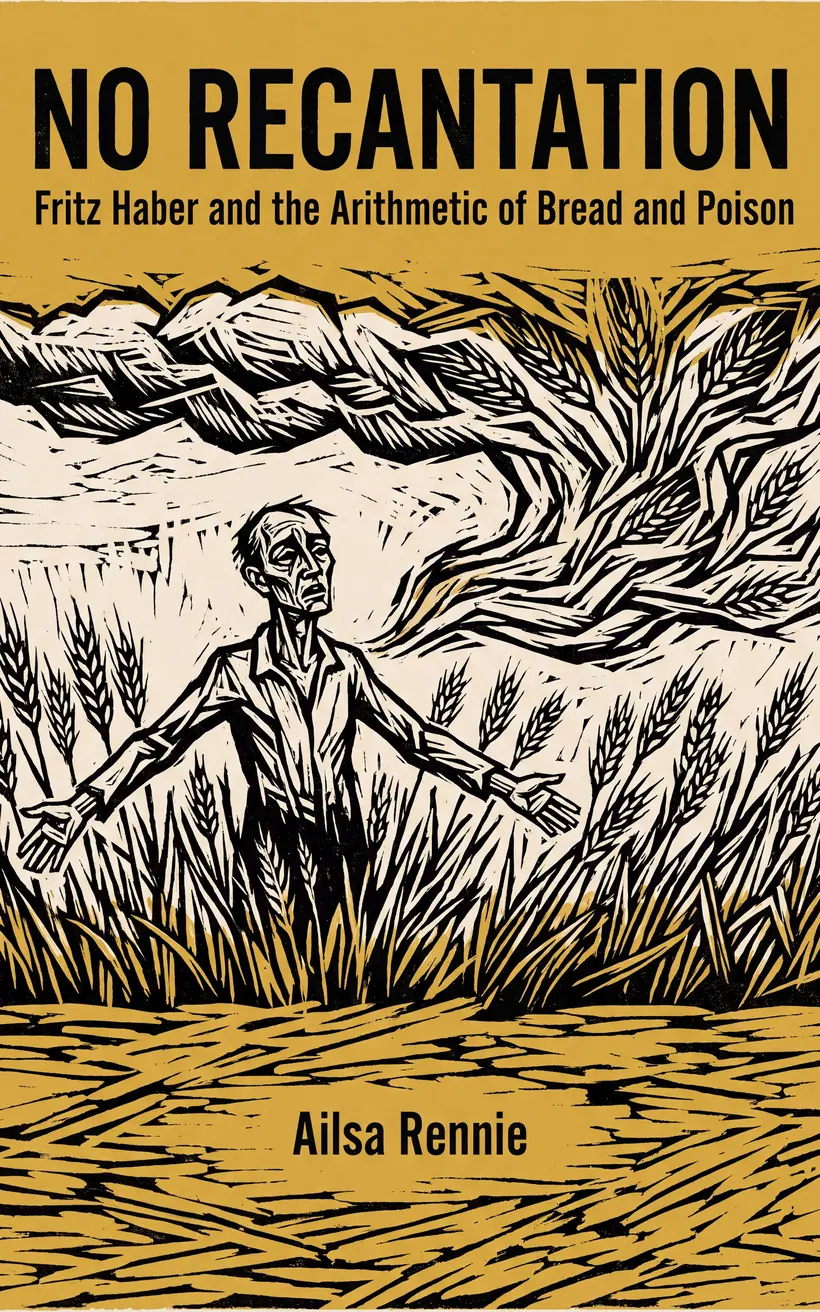
Fritz Jakob Haber. The title never carries the subject's name: it names one concrete thing out of the life — in this case No Recantation — and the name goes on the line underneath.
No. No subject, estate, label or foundation had approval over the text, and none paid for a word of it. The cost of that independence is that no new interviews were conducted for the book; it is built from the public record, and it says on the page where a scene is reconstructed rather than documented.
Yes — the whole opening chapter and the writer's foreword, free and in full, with no email address and no account. That is 4,084 words of the book.
About 68,500 words, 21 chapters, 222 pages in the paperback.