
The Birkbeck Years
Paperback
Download link emailed the moment payment clears.
3,987 words · no email, no account
No. 282 · Science · Science
a biography of Augusta Ada King, Countess of Lovelace
She died at thirty-six, on 27 November 1852, and was buried at Hucknall beside the father she had never knowingly met. Her mother had taken charge of the sickroom by then, and eventually of the patient's soul. What Augusta Ada King told her husband at the bedside is the largest hole in the record, and this book leaves it open.
In 1843 her translation of Luigi Federico Menabrea's paper on Charles Babbage's Analytical Engine appeared in Scientific Memoirs, with seven notes appended, lettered A through G, roughly three times the length of the paper they annotated and signed with three initials. She had never published anything before. The quarrel over what she is owed for it has run since 1970, in the same two positions: the first computer programmer, or Babbage's translator with a title and a famous surname.
It has been fought over the wrong page. Both camps reach for Note G, the Bernoulli table, the weakest ground her defenders could have chosen. Babbage had drafted some two dozen sample programs between 1837 and 1840, wrote in print in 1864 that he had worked the Bernoulli algebra himself to save her the trouble, and the table carries an error at operation four. Note A is the page that matters. There she defines an operation as any process that alters the mutual relation of things, writes that the Engine might act on objects other than number if their relations could be got into the notation, names music as the case, and asserts a science of operations distinct from the science of number. That is general-purpose computation, and Babbage did not write it down.
The competence question is settled on evidence no popular biography has used: the mathematics Augustus De Morgan taught her by post between 1840 and 1841, her errors and his corrections surviving, reappraised by Christopher Hollings, Ursula Martin and Adrian Rice. A serious, uneven, rapidly improving student of an unusually good teacher, satisfying neither myth. Note A is still hers.
The opening chapter is published in full — read it here.
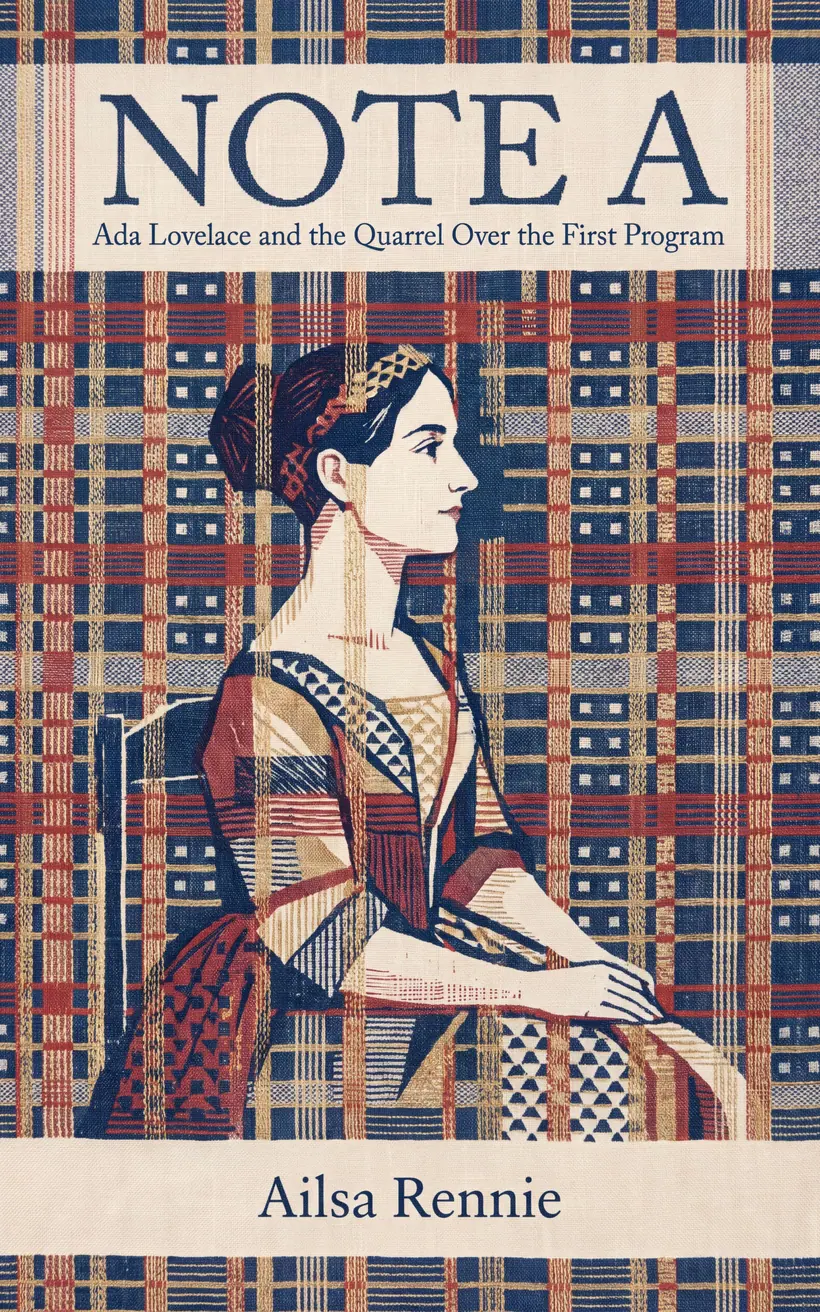
Augusta Ada King, Countess of Lovelace. The title never carries the subject's name: it names one concrete thing out of the life — in this case Note A — and the name goes on the line underneath.
No. No subject, estate, label or foundation had approval over the text, and none paid for a word of it. The cost of that independence is that no new interviews were conducted for the book; it is built from the public record, and it says on the page where a scene is reconstructed rather than documented.
Yes — the whole opening chapter and the writer's foreword, free and in full, with no email address and no account. That is 3,987 words of the book.
About 71,500 words, 22 chapters, 232 pages in the paperback.