The Birkbeck Years
Paperback
Download link emailed the moment payment clears.
4,063 words · no email, no account
No. 283 · Science · Science
a biography of Carl Edward Sagan
Was there a research record to vote against? In 1992 the National Academy of Sciences declined to elect Carl Sagan. He was blackballed in the first round, which forced a debate and a vote of the whole membership, and he finished at roughly fifty percent against a two-thirds threshold. Members who described the session afterward reported that Cosmos was dismissed in the room as fluff. One, unnamed, said that if he had not done television he probably would be in the Academy. Two years later the same Academy awarded him its Public Welfare Medal.
The book takes the Academy on its own terms. It votes on research, so the research comes first: fourteen of the twenty-two chapters end before Cosmos airs in 1980. Venus, argued at twenty-six in 1961, is not a swamp but an oven, cooked past the melting point of lead by a runaway greenhouse, with Mariner 2 flying past in December 1962 to find it. Mars through the 1960s: the seasonal wave of darkening explained as wind-blown dust rather than vegetation, settled when Mariner 9 arrived in November 1971 into the largest dust storm ever observed. Tholins on Titan. The Pioneer plaque, the Voyager record, a seat on the Viking imaging team. The answer is yes.
That is not a defence of everything. The one serious procedural charge — that in 1983 the nuclear winter finding reached a Parade cover of tens of millions before the peer-reviewed paper appeared in Science — goes unadjudicated, and the book says plainly that this is where it is least able to defend him. It records what followed: the model corrected, the numbers moderated in 1990, and three-dimensional work from about 2007 returning conclusions as severe as the original. On the vote itself it fills no gaps. No tally is public, the proceedings are confidential, and no living Academy member is named as having voted against him. He died in Seattle on 20 December 1996, at sixty-two. The profession that voted him down now creates professorships in the thing it voted against.
The opening chapter is published in full — read it here.
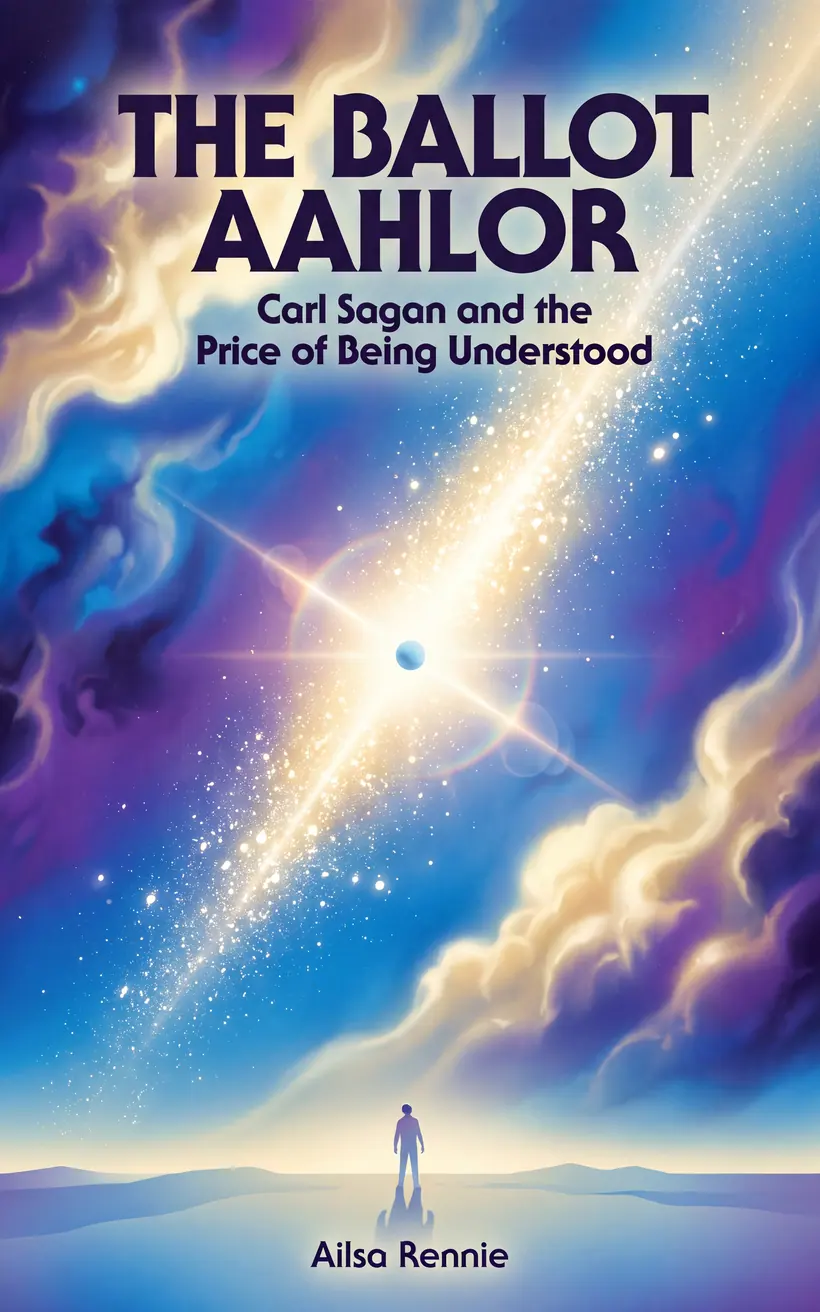
Carl Edward Sagan. The title never carries the subject's name: it names one concrete thing out of the life — in this case The Ballot — and the name goes on the line underneath.
No. No subject, estate, label or foundation had approval over the text, and none paid for a word of it. The cost of that independence is that no new interviews were conducted for the book; it is built from the public record, and it says on the page where a scene is reconstructed rather than documented.
Yes — the whole opening chapter and the writer's foreword, free and in full, with no email address and no account. That is 4,063 words of the book.
About 70,000 words, 22 chapters, 226 pages in the paperback.