The Birkbeck Years
Paperback
Download link emailed the moment payment clears.
4,144 words · no email, no account
No. 284 · Science · Science
a biography of Sir Alexander Fleming
The Inoculation Department at St Mary's stood on Praed Street in Paddington, a floor run by Sir Almroth Wright on the doctrine that the body's own defences were the answer. It was hostile to chemotherapy, contemptuous of statistics, paid its own wages by selling vaccines, and employed no biochemist. Into it came a Scottish farmer's son off eight hundred acres of Ayrshire moor above Darvel: four miles to school, his father dead when he was seven, four years copying bills of lading as a shipping clerk, an uncle's legacy in 1901 that bought a medical education, and a research career settled because the captain of the hospital rifle team wanted to keep a good shot at St Mary's. Penicillin was a chemistry problem. Nobody on that floor did chemistry. Seven of the twenty-one chapters pass before the plate appears in 1928, and Chapter 12 contains no Alexander Fleming, on purpose.
The usual argument is that he stumbled onto it, failed to see what he had, and spent his later years taking credit for what Howard Florey, Ernst Chain and Norman Heatley did at Oxford. He did stumble, and he never claimed otherwise. But in November 1930 a pathologist named Cecil George Paine, who had been his student, treated eye infections at the Sheffield Royal Infirmary with crude penicillin filtrate, among them newborn babies with gonococcal infection, in that period a known cause of blindness. The filtrate worked. Paine did not publish; Milton Wainwright brought the record out in the 1980s. Those are the first documented human cures, and they turn the eleven years from one man's failure of imagination into a country's. No letter, notebook entry or recorded conversation explains why Fleming gave up between 1929 and 1939, and Chapter 10 states that rather than supplying a motive. From the Stockholm stage on 11 December 1945 he described the drug sold over a counter, the dose too small, the microbe educated rather than killed. The organisms are still learning.
The opening chapter is published in full — read it here.
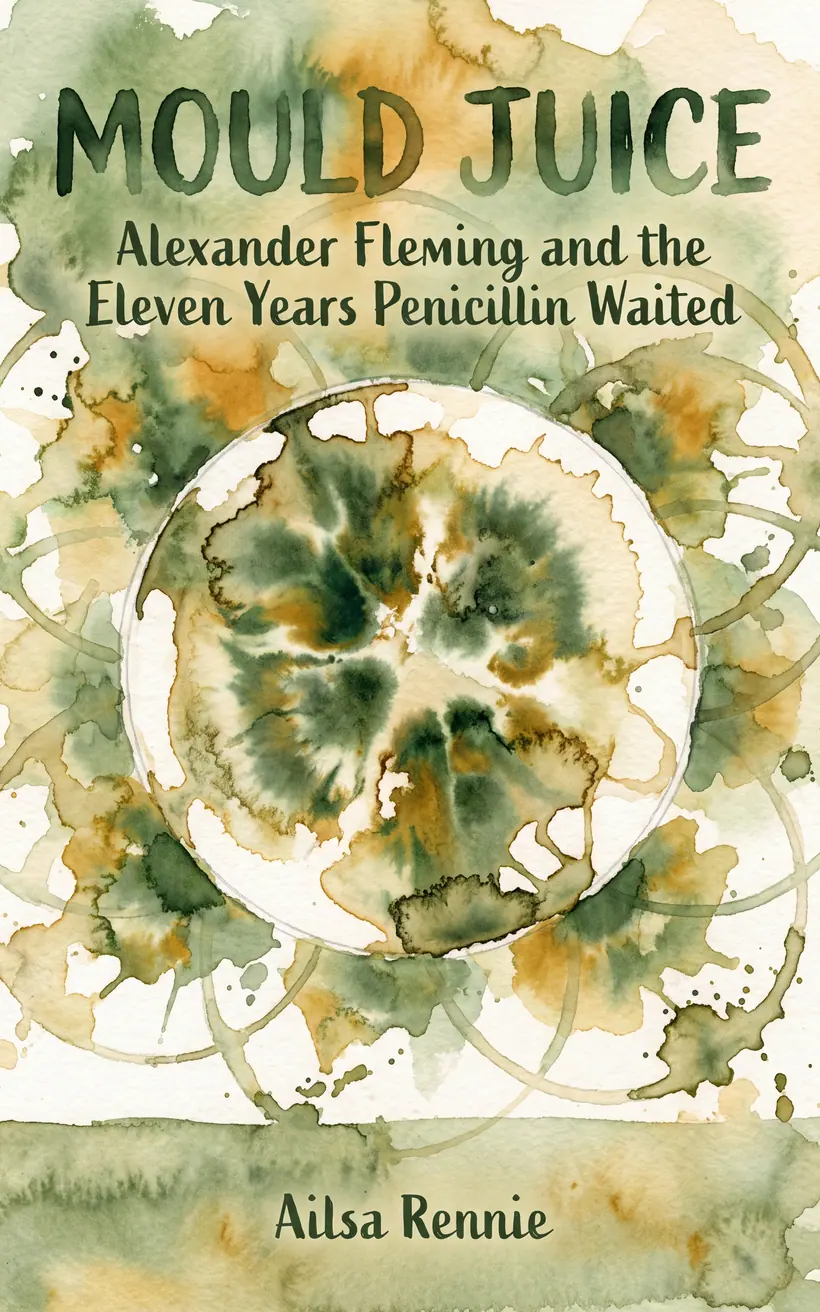
Sir Alexander Fleming. The title never carries the subject's name: it names one concrete thing out of the life — in this case Mould Juice — and the name goes on the line underneath.
No. No subject, estate, label or foundation had approval over the text, and none paid for a word of it. The cost of that independence is that no new interviews were conducted for the book; it is built from the public record, and it says on the page where a scene is reconstructed rather than documented.
Yes — the whole opening chapter and the writer's foreword, free and in full, with no email address and no account. That is 4,144 words of the book.
About 67,500 words, 21 chapters, 220 pages in the paperback.