The Opening
Paperback
Download link emailed the moment payment clears.
4,178 words · no email, no account
No. 285 · Power & Politics · History
a biography of Alexander III of Macedon
Roughly six thousand killed at Thebes and thirty thousand sold. At Tyre, eight thousand killed and thirty thousand enslaved on Arrian's figures; seven thousand killed, two thousand crucified and thirteen thousand enslaved on Diodorus'. At Persepolis, no figure. For two years of population war in Bactria and Sogdiana, no figure at all. This book keeps the account city by city, attributes every number to the source that supplies it and prints it as a spread, on the stated principle that ancient casualty figures are not measurements. The zeros are entered too. Babylon surrendered and was not sacked, and Porus was beaten at the Hydaspes and then reinstated as a client king over more territory than he had lost.
Almost everything known about Alexander III of Macedon reaches us through men who were on his payroll. Ptolemy and Aristobulus wrote the accounts Arrian made canonical four and a half centuries later; the killings Arrian passes over survive only through Cleitarchus, Curtius and Diodorus, who had reasons of their own. No contemporary narrative of the life survives at all. The case here runs from the ground and the tablets rather than the narrative: terror was a component of the method, not a lapse in it, introduced at Thebes in 335, industrialized at Tyre in 332 over a seven-month siege against an island city half a mile offshore, normalized afterward into two years nobody writes about.
Several chapters are corrections. Gaugamela is told twice, from Arrian's staff account and from a Babylonian astronomical diary written in cuneiform within days, which records the defeat, the panic and the price of barley. Not one ancient speech is quoted as speech. He was dead at thirty-two, eleven days into a fever in Babylon, and nobody knows what killed him. The tablets that make this accounting possible are unfired clay, which does not last in the ground. They lasted because his fire baked them hard in 330 and the wall came down on them. He burned the building.
The opening chapter is published in full — read it here.
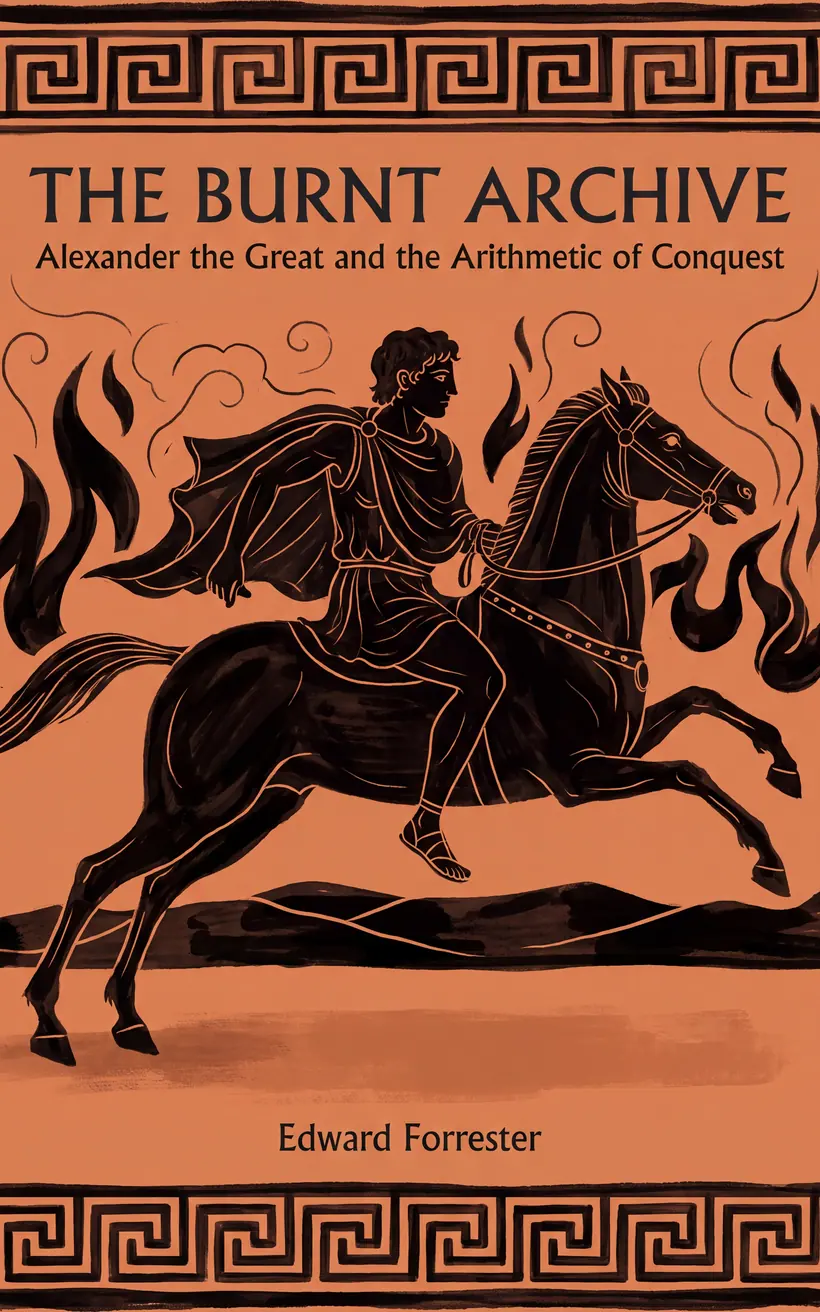
Alexander III of Macedon. The title never carries the subject's name: it names one concrete thing out of the life — in this case The Burnt Archive — and the name goes on the line underneath.
No. No subject, estate, label or foundation had approval over the text, and none paid for a word of it. The cost of that independence is that no new interviews were conducted for the book; it is built from the public record, and it says on the page where a scene is reconstructed rather than documented.
Yes — the whole opening chapter and the writer's foreword, free and in full, with no email address and no account. That is 4,178 words of the book.
About 72,000 words, 22 chapters, 232 pages in the paperback.