The Opening
Paperback
Download link emailed the moment payment clears.
4,217 words · no email, no account
No. 289 · Power & Politics · History
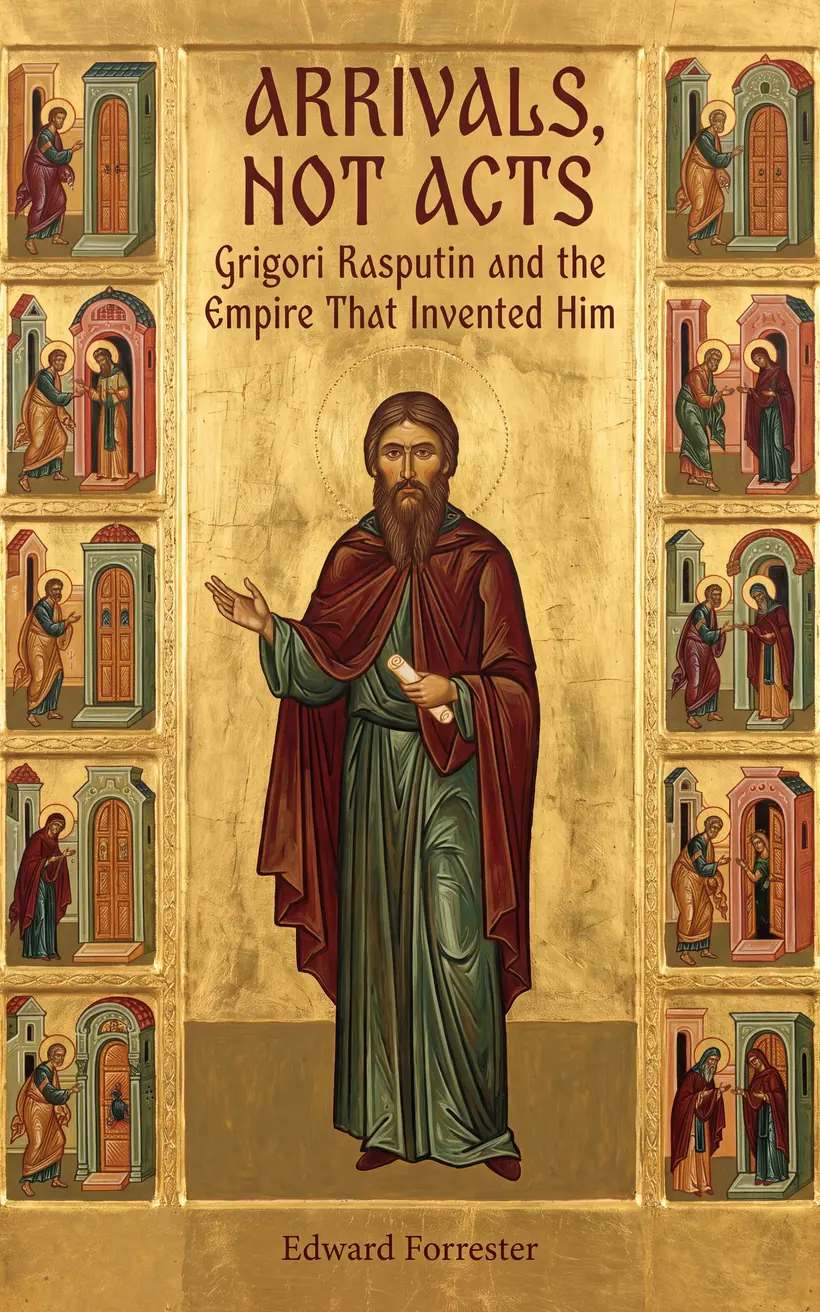
a biography of Grigori Yefimovich Rasputin
Grigori Rasputin held no office and commanded nothing. He is nevertheless among the handful of names most often blamed for the collapse of a three-hundred-year empire, and when men who believed that killed him in December 1916 to save the monarchy, the monarchy outlived him by ten weeks. This book argues that his importance was never proportional to his power, and that this is the interesting fact about him, not a debunking of it. What he did for the Empress's hemophiliac son Alexei at Spala in October 1912, a boy bleeding after a carriage ride, last rites prepared, a telegram from Pokrovskoye, a recovery, cannot be established; three explanations are set out and none is chosen. What Alexandra concluded can be established, and her conclusion is what changed history.
What can be documented is the manufacture of the figure. In 1912 Alexander Guchkov circulated copies of the Empress's letters among Duma politicians, reading them where they would be repeated. The press did the rest. The monk Iliodor, who had built Rasputin's reputation among the faithful and then set out to demolish it, wrote The Holy Devil, from which nearly every famous anecdote descends. The political police kept ledgers on the staircase of his flat on Gorokhovaya Street: who climbed it, at what hour, in what condition. They are the most detailed documentation of any life in late imperial Russia, they were compiled by men whose advancement depended on finding something, and they record arrivals, not acts. The autopsy after the cellar on the Moika destroys most of the legend. No poison, no water in the lungs, three gunshot wounds, one to the forehead at close range, none of the mutilation the rumours promised — though the original report did not survive, and what the book has is the pathologist's later account. Then the Extraordinary Commission of Inquiry of 1917, which took testimony from the fallen regime's ministers, courtiers and police and has been quoted as neutral for a century.
The opening chapter is published in full — read it here.
Grigori Yefimovich Rasputin. The title never carries the subject's name: it names one concrete thing out of the life — in this case Arrivals, Not Acts — and the name goes on the line underneath.
No. No subject, estate, label or foundation had approval over the text, and none paid for a word of it. The cost of that independence is that no new interviews were conducted for the book; it is built from the public record, and it says on the page where a scene is reconstructed rather than documented.
Yes — the whole opening chapter and the writer's foreword, free and in full, with no email address and no account. That is 4,217 words of the book.
About 70,000 words, 22 chapters, 226 pages in the paperback.