The Opening
Paperback
Download link emailed the moment payment clears.
4,184 words · no email, no account
No. 290 · Power & Politics · History
a biography of Musa I of Mali, called Mansa Musa
He ran out of money on the road home. The king supposedly drowning Cairo in gold sold back at half price the goods he had bought at a premium, and borrowed; Ibn Khaldun puts fifty thousand dinars on one Cairo merchant house alone, and reports the loans unpaid or part-paid. Both halves of the sentence everyone knows are wrong. Musa I of Mali was not measurably the richest man who ever lived: the figure that circulates is a modern net-worth extrapolation, and the medieval authority under it is a Majorcan map of about 1375 whose caption calls a crowned Black king the richest and the noblest of these lands. A regional claim, read as a global one for six hundred years.
The caravan entered Cairo on 19 July 1324 and left on 18 October. In those ninety days Mamluk officials took the king's gifts and took notes, and about twelve years later the chancery official al-Umari wrote them up from interviews with the men assigned to him. That is very nearly the entire documentary record. Mansa Musa left no chronicle, no inscription, no likeness made from life, no tomb, not one word in his own hand. The early chapters belong to the world that produced him: Ghana as al-Bakri described it from Cordoba in 1068 without ever going there; the goldfields of Bure and Bambuk, washed by people who were never Malian subjects and never conquered; Taghaza, where enslaved miners cut salt from a dry lakebed in a settlement roofed with camel skin. Mali taxed the road and not the mine, which is why the wealth could be walked around when Portuguese caravels reached Arguin in the 1440s.
The evidence is graded on the page. The famous caravan figures are handled as magnitudes rather than counts. The Ta'rikh al-Fattash is excluded entirely. Enslaved people stay where the sources put them, in the goldfields, the salt mines and the caravan. Four times the book says we do not know: about the birth, the death, the burial and the face.
The opening chapter is published in full — read it here.
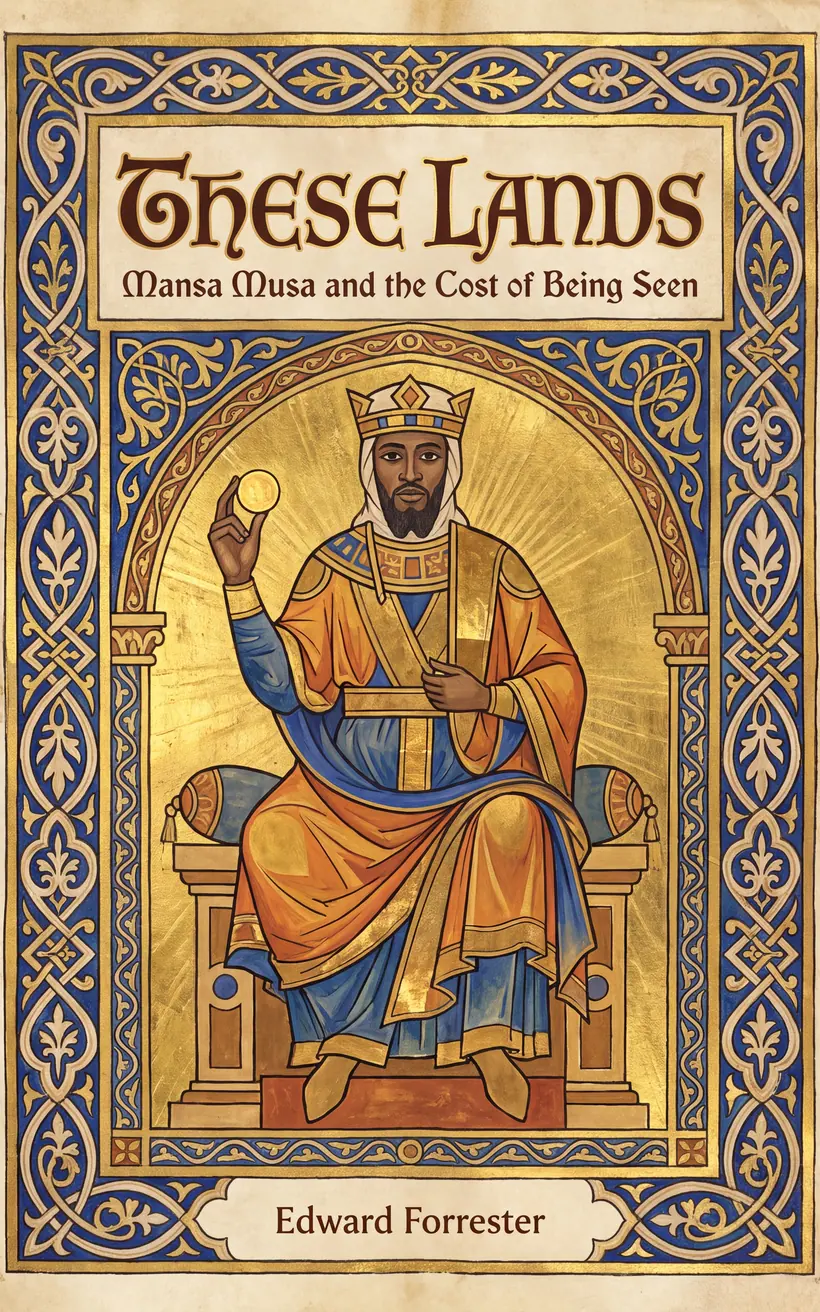
Musa I of Mali, called Mansa Musa. The title never carries the subject's name: it names one concrete thing out of the life — in this case These Lands — and the name goes on the line underneath.
No. No subject, estate, label or foundation had approval over the text, and none paid for a word of it. The cost of that independence is that no new interviews were conducted for the book; it is built from the public record, and it says on the page where a scene is reconstructed rather than documented.
Yes — the whole opening chapter and the writer's foreword, free and in full, with no email address and no account. That is 4,184 words of the book.
About 67,500 words, 21 chapters, 220 pages in the paperback.