The Opening
Paperback
Download link emailed the moment payment clears.
3,999 words · no email, no account
No. 291 · Power & Politics · History
a biography of Catherine II of Russia, born Sophie Auguste Friederike von Anhalt-Zerbst
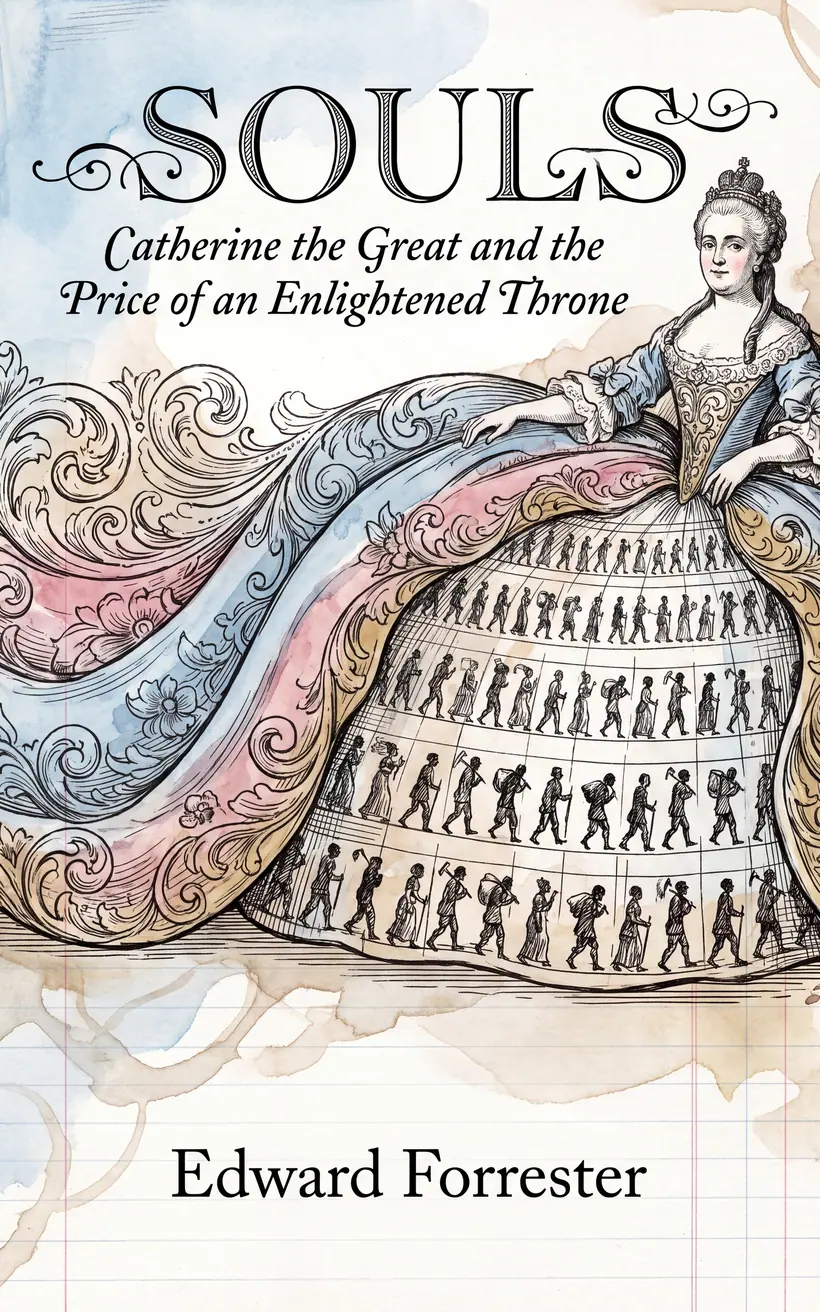
Who paid for the Russian throne, and in what? Catherine II of Russia took it by a coup on the night of 27-28 June 1762, when the Guards regiments swore to her: a German princess with no Russian blood and no legal claim, whose husband Peter III was dead in custody at Ropsha eight days later. She was not crowned until 22 September. In the summer that lay between the oath and the crown, the first grants of souls went out under her signature. A soul was not a figure of speech. It was the unit in which a rural population was counted, taxed and conveyed. She settled with her creditors before the Church had put the crown on her head, and this book argues that her Enlightenment and her serfdom were one transaction, understood perfectly by the woman who made it.
She meant the Nakaz. Published in 1767 and assembled openly out of Montesquieu and Beccaria, it condemned torture and set law above the ruler's whim. The Legislative Commission she convened that summer seated more than five hundred elected deputies, and the noble deputies used it to demand more power over their serfs. That same year a decree forbade serfs to petition the crown against their owners. The provincial reform of 1775 handed the countryside to the gentry, serfdom was extended into Left-Bank Ukraine in 1783, and the Charter to the Nobility of 1785 made the nobility a legal estate holding property in human beings. Instalments, not failures of nerve. The account runs from a Prussian garrison town on the Oder in 1729 to the Winter Palace in 1796 and a son going through her papers, by way of Pugachev, Potemkin, the Crimea, Voltaire, and Diderot's library, bought with Diderot kept on as its librarian. It refuses the pornography her enemies produced within a generation of her death, and the tribute Russian officialdom has wanted since 2014. It publishes its gaps rather than filling them: Ropsha, the paternity of her son, the marriage to Potemkin for which there is no register and no witness.
The opening chapter is published in full — read it here.
Catherine II of Russia, born Sophie Auguste Friederike von Anhalt-Zerbst. The title never carries the subject's name: it names one concrete thing out of the life — in this case Souls — and the name goes on the line underneath.
No. No subject, estate, label or foundation had approval over the text, and none paid for a word of it. The cost of that independence is that no new interviews were conducted for the book; it is built from the public record, and it says on the page where a scene is reconstructed rather than documented.
Yes — the whole opening chapter and the writer's foreword, free and in full, with no email address and no account. That is 3,999 words of the book.
About 64,500 words, 21 chapters, 210 pages in the paperback.