The USC Film School
Paperback
Download link emailed the moment payment clears.
4,126 words · no email, no account
No. 294 · Screen & Stage · Film
a biography of Stanley Kubrick
Four things in this book are named and left empty: what Sue Lyon experienced, whether the released Eyes Wide Shut is Kubrick's film, why The Aryan Papers really stopped, and whether Stanley Kubrick ever understood what his method cost the people it cost. No document answers the last one. The archive that preserves the whole of a working method preserves nothing about the man who ran it. That archive is why the book is possible: roughly a thousand containers left Childwickbury Manor in October 2007, while the two standard biographies were both published in 1997.
Open the file and the legends do not survive it. For four decades the record books gave the most-retaken scene in cinema as a hundred and twenty-seven takes of Shelley Duvall backing up a staircase with a bat. In July 2020 the figure quietly became a hundred and forty-eight, attached to a different scene, unexplained. Then in 2023 Lee Unkrich counted from the production's own continuity paper and found the true maximum was sixty-six, for the long dolly move into the Gold Ballroom. Only the last of the three was counted from anything. The correction is not an exoneration and the book declines to use it as one. Sixty-six takes of a single camera move is still a demand outside the practice of any comparable director. What the revision destroys is confidence in a literature that repeated a vivid claim for forty years because nobody had opened the file. The argument that replaces it: perfectionism was not a temperament but a transfer, a method that moved the cost of an image off the screen and onto a body, almost always the body with the least power in the room. Malcolm McDowell has held two positions for fifty years, that he would do it again and that Kubrick never called him afterward. Sue Lyon was fourteen. Duvall said she cried twelve hours a day, and said in 2021 that he had been warm and friendly to her. The method was constant. The outcomes were not, and the variable was standing.
The opening chapter is published in full — read it here.
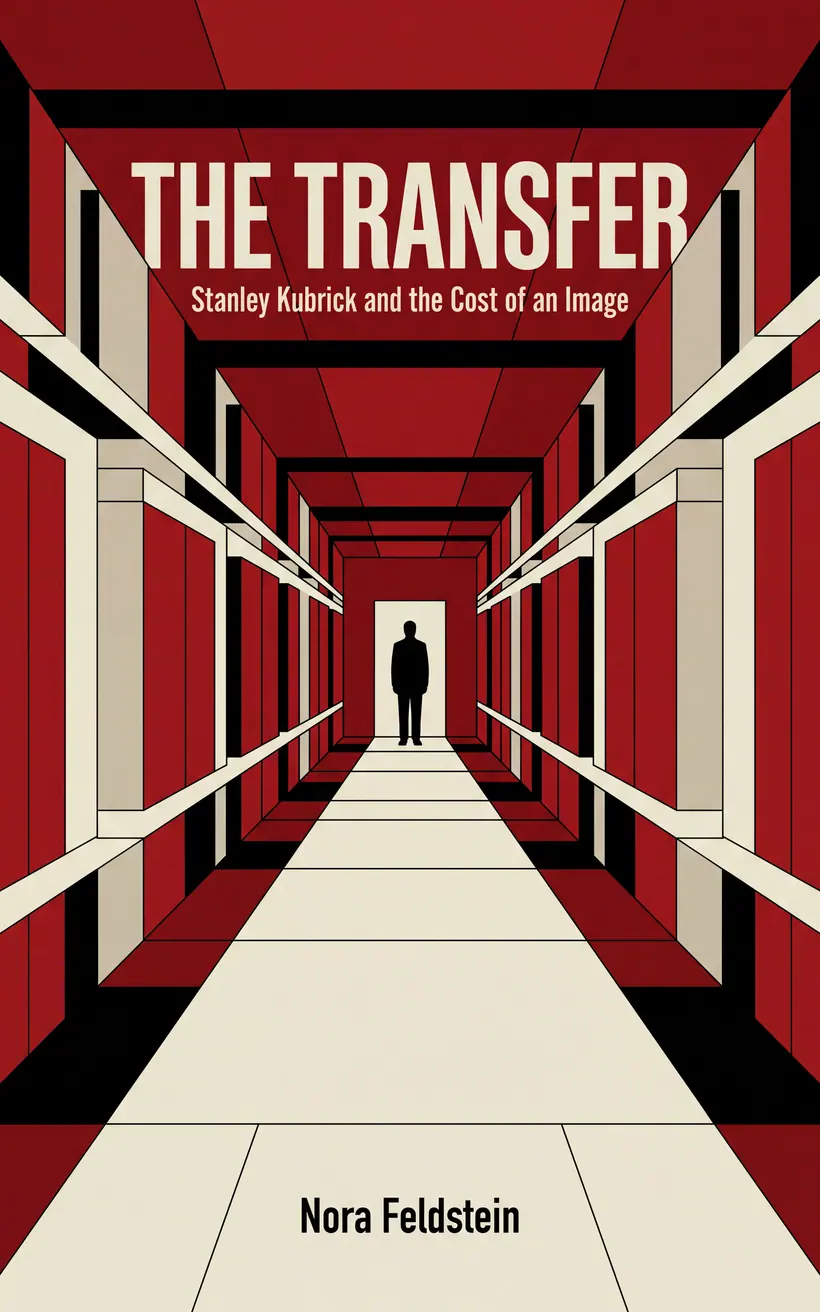
Stanley Kubrick. The title never carries the subject's name: it names one concrete thing out of the life — in this case The Transfer — and the name goes on the line underneath.
No. No subject, estate, label or foundation had approval over the text, and none paid for a word of it. The cost of that independence is that no new interviews were conducted for the book; it is built from the public record, and it says on the page where a scene is reconstructed rather than documented.
Yes — the whole opening chapter and the writer's foreword, free and in full, with no email address and no account. That is 4,126 words of the book.
About 58,000 words, 21 chapters, 190 pages in the paperback.