The USC Film School
Paperback
Download link emailed the moment payment clears.
4,313 words · no email, no account
No. 297 · Screen & Stage · Film
a biography of George Orson Welles
Orson Welles's unfinished films were finished exactly as far as the money went. From 1948 he paid for his own pictures out of fees for acting in other people's, which meant the work got made when he had been paid and stopped when he had not. Othello was shot across three countries over three years. Don Quixote ran twelve years, until an actor died, and was never assembled. The battle in Chimes at Midnight is cut from short takes because he could not afford enough extras to hold a wide shot. The Other Side of the Wind was shot in pieces over six years, then impounded in Paris by the revolution in Iran.
He worked that way because of thirty months at RKO, the smallest and weakest of the five majors, newly out of receivership, whose head George Schaefer had come from distribution with a strategy of buying prestige. The contract he signed in August 1939 gave a twenty-four-year-old who had never made a feature a production unit, the actors he brought with him, and final cut, subject to a budget ceiling and a running-time limit. No untried filmmaker has been given those terms at a major studio in the eight decades since, and Welles refused for the rest of his life to work on any others. Citizen Kane arrives at chapter ten; twelve follow it, among them the Pomona preview of The Magnificent Ambersons in 1942 and the forty-three minutes cut out of it and destroyed.
Two chapters are not about him. One belongs to Manoel Olimpio Meira, called Jacaré, who sailed a raft sixteen hundred and fifty miles to win labor protections for the poorest workers in Brazil and drowned during a reenactment for a film camera; the book states that it does not know who was responsible. Another opens and closes on Isaac Woodard, blinded in police custody in South Carolina in 1946, whose affidavit Welles read on national radio. Six pieces of his work have become available since he died, and those chapters say what is on the screen, not what has been said about it.
The opening chapter is published in full — read it here.
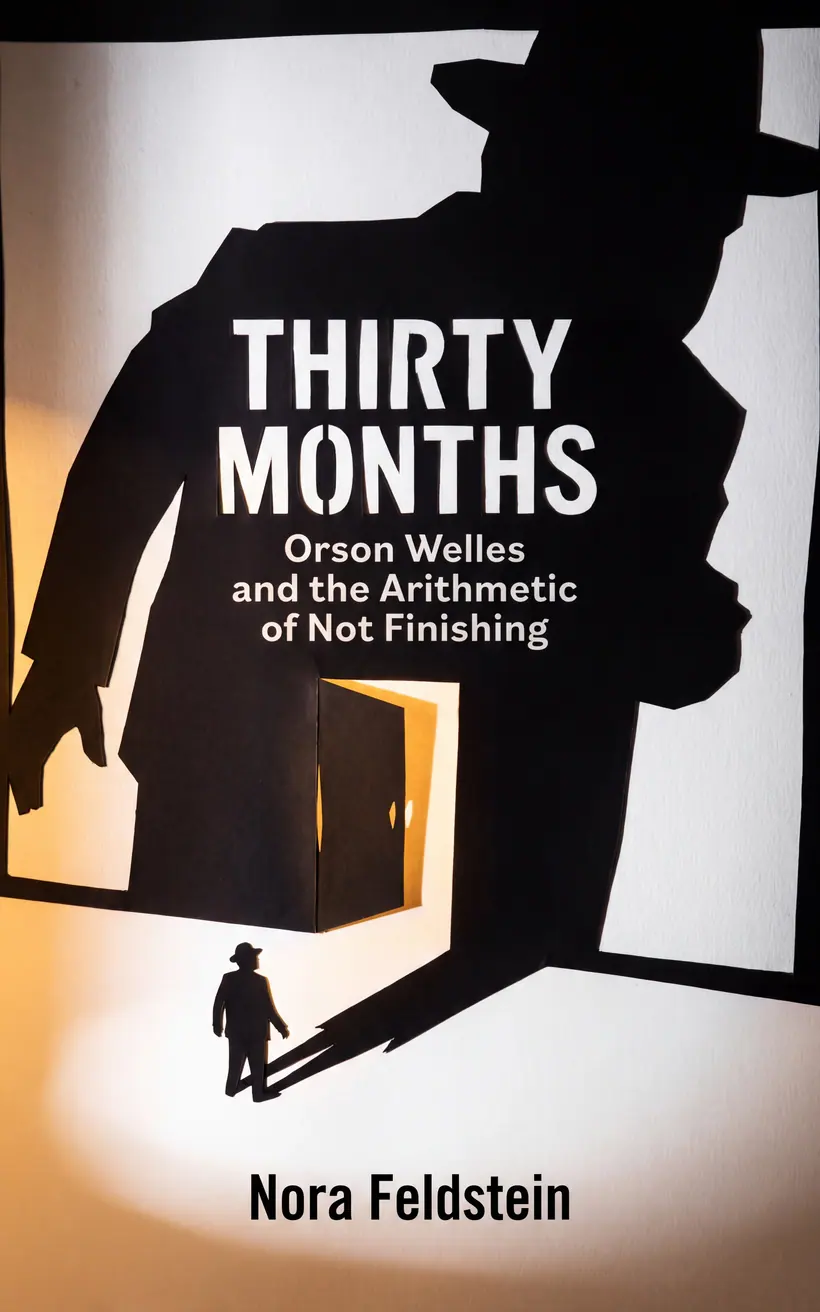
George Orson Welles. The title never carries the subject's name: it names one concrete thing out of the life — in this case Thirty Months — and the name goes on the line underneath.
No. No subject, estate, label or foundation had approval over the text, and none paid for a word of it. The cost of that independence is that no new interviews were conducted for the book; it is built from the public record, and it says on the page where a scene is reconstructed rather than documented.
Yes — the whole opening chapter and the writer's foreword, free and in full, with no email address and no account. That is 4,313 words of the book.
About 56,500 words, 22 chapters, 186 pages in the paperback.