The Annina Nosei Gallery
Paperback · Hardcover
Ships in 2 to 5 working days. Delivery quoted from your address at checkout.
5,464 words · no email, no account
No. 066 · Art & Design · Visual Art
a biography of Ai Weiwei
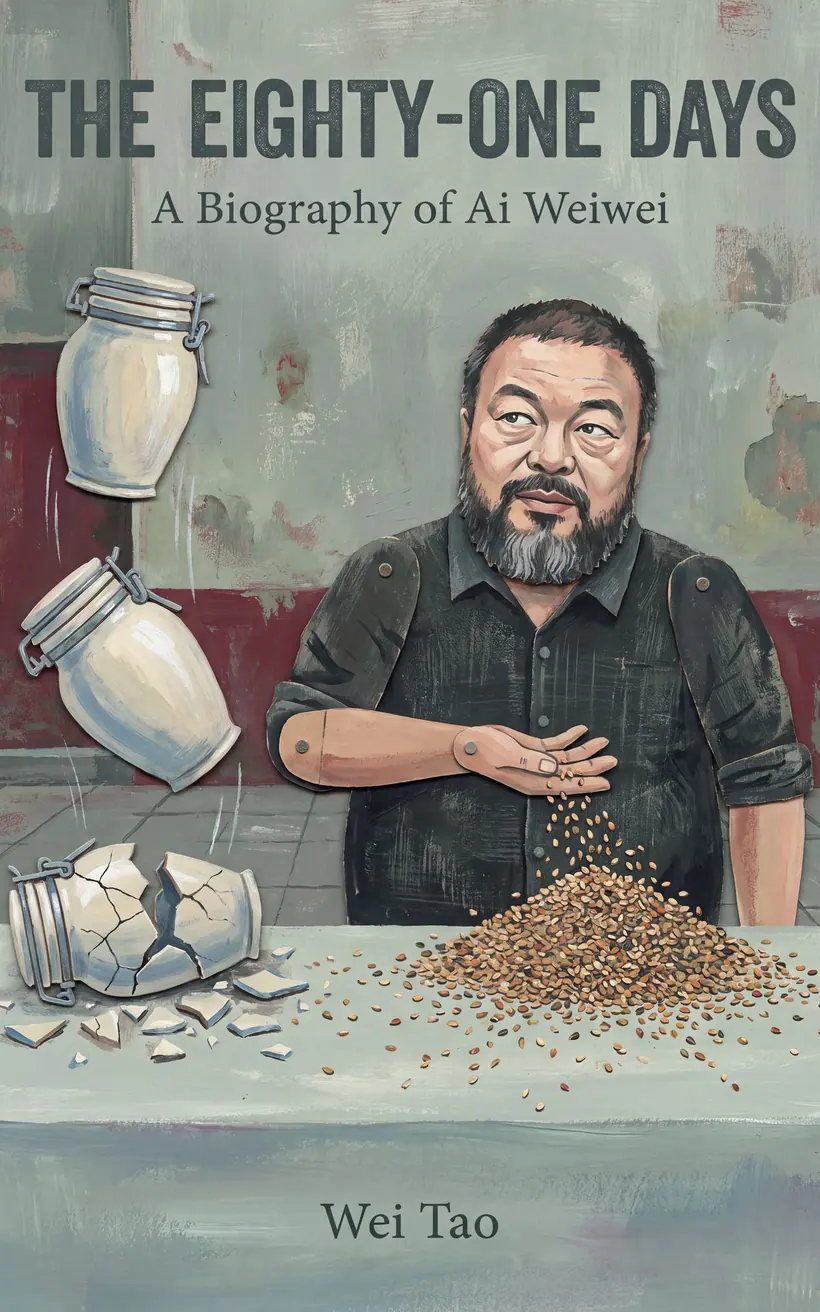
In a Beijing courtyard strewn with Han dynasty urns, a man lifts one above his head and lets it fall. The shutter clicks three times. The gesture — destruction as devotion, vandalism as inheritance — would come to define a life lived at the seam where art meets the state.
Wei Tao traces the long arc of Ai Weiwei from his childhood in exile, where his father, the poet Ai Qing, was sent to clean latrines in the Gobi, through the downtown Manhattan years of the eighties, the return to a transforming China, and the studio at Caochangdi that became both workshop and lightning rod. He follows the porcelain sunflower seeds into the Turbine Hall, the names of the Sichuan earthquake children onto a museum wall, the eighty-one days of detention into the work that came after.
Drawing on years of interviews, family correspondence, and the artist's own prolific archive of blog posts, tweets, and surveillance footage, Tao assembles a portrait of a man who has insisted, against considerable cost, that a life and a practice cannot be separated.
What emerges is less a chronicle of provocations than a study of inheritance — of what a son owes a father, what an artist owes a public, and what it means to make objects in a country that would prefer you make none at all.</p>
The opening chapter is published in full — read it here.
The printed edition has no ISBN registered yet. It affects library and retail listing, not your order.
Ai Weiwei. The title never carries the subject's name: it names one concrete thing out of the life — in this case The Eighty-One Days — and the name goes on the line underneath.
No. No subject, estate, label or foundation had approval over the text, and none paid for a word of it. The cost of that independence is that no new interviews were conducted for the book; it is built from the public record, and it says on the page where a scene is reconstructed rather than documented.
Yes — the whole opening chapter and the writer's foreword, free and in full, with no email address and no account. That is 5,464 words of the book.
About 62,500 words, 18 chapters, 196 pages in the paperback.
6 × 9 in, 60# uncoated cream, black ink, perfect-bound paperback, matte laminate. Every title in the series uses the same specification, so they line up on a shelf.
Paperback · Hardcover
Paperback · Hardcover
Paperback